



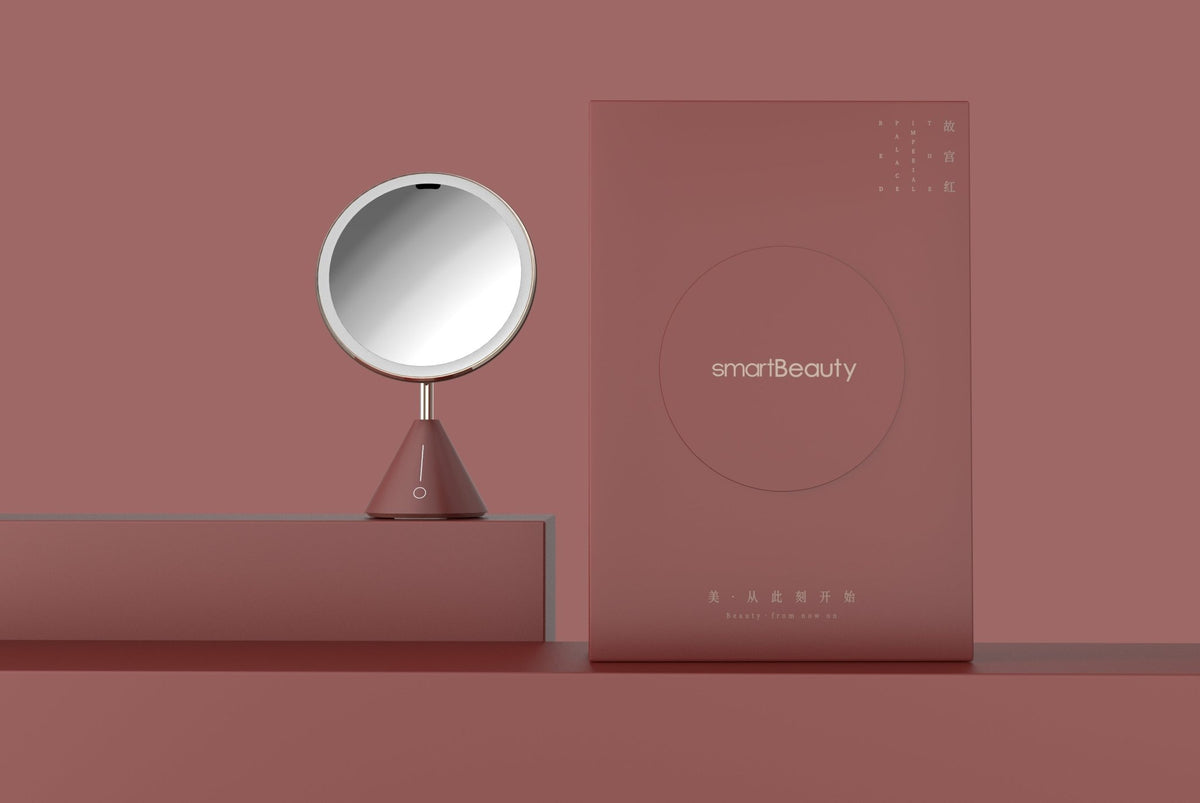
The best LED makeup mirror for everyday use combines even front-facing illumination, high color rendering, adjustable brightness, suitable color temperatures and a clear, comfortable viewing area. For detailed work, a separate magnifying mirror can be useful. Look beyond the number of LEDs: how the light reaches your face and how accurately it reveals makeup colors matter more than maximum brightness alone.
Have you ever applied foundation at home only to find that it looks too warm, too heavy or uneven outside? Your makeup may not be the only reason. The lighting around your mirror influences the way you see skin tone, texture and color. This guide explains which specifications matter, how to compare lighted mirrors and what TOUCHBeauty has learned through its makeup mirror development.
Why does makeup look different in different lighting?
Light changes the way colors and shadows appear. A warm bedroom lamp may make a foundation shade look more golden, while a cool overhead light can make the same shade appear different. Light from one side can create shadows that hide uneven blending on the other side. A bright ceiling light can also cast shadows under the brows, nose and chin.
A good makeup setup starts with a stable mirror and balanced illumination from the front. Try matching foundation along the jawline, checking both sides of the face and viewing the result near a window in indirect daylight when available. No single lamp can reproduce every real-world lighting environment, so checking your makeup under more than one condition can be useful.
7 features to look for in an LED makeup mirror
1. Even illumination, not just more LEDs
Look for a light source that illuminates both sides of your face without obvious hot spots or harsh shadows. A front-facing ring, diffused side lights or a well-designed light guide can help distribute illumination. A decorative backlight behind the mirror may brighten the wall without providing enough useful light on the face.
When comparing mirrors in person, stand or sit at your normal makeup distance. Check whether the light reaches your jawline and the area around your eyes. The LED count alone does not tell you how uniform the illumination will be.
2. High color rendering (CRI or Ra)
The color rendering index describes how faithfully a light source reveals the colors of objects relative to a reference illuminant. General CRI, often written as Ra, uses a scale with a maximum of 100. A rating of 90 or higher is a useful shopping target for color-sensitive makeup tasks, not a universal requirement or a guarantee of perfect shade matching.
Ra is an average based on a limited set of test colors. It does not tell you everything about saturated reds, all skin tones or the quality of the light distribution. If a manufacturer provides additional color-rendering measurements, such as R9 for saturated red, those can help you compare products. Learn more about lighting color metrics from the National Institute of Standards and Technology.
3. Adjustable color temperature (Kelvin)
Correlated color temperature, or CCT, describes the warm or cool appearance of white light. It is measured in kelvin (K). Unlike brightness, a higher kelvin value does not mean a stronger light. Unlike CRI, CCT does not indicate how faithfully colors are rendered. A mirror with multiple white-light settings makes it easier to preview a look under different lighting conditions.
| Light setting | Illustrative range | Useful for |
|---|---|---|
| Warm white | 2700–3500 K | Evening looks and warm indoor lighting |
| Neutral / daylight-like white | 4000–5000 K | Everyday makeup and shade checks |
| Cool white | 5500–6500 K | Checking a look under cooler indoor light |
These are general shopping examples, not specifications for every TOUCHBeauty model. Natural daylight changes throughout the day, so even a daylight-like setting cannot reproduce every outdoor situation. For technical background, see the U.S. Department of Energy’s color and spectrum resources.
4. Adjustable brightness and visual comfort
A mirror used in a dark bedroom may need a different light level than one placed next to a sunny window. Stepless dimming lets you make small adjustments instead of selecting only a few fixed levels. Choose a comfortable brightness that reveals details without making you squint or creating distracting reflections.
If a manufacturer lists illuminance in lux, check the measurement distance. A reading taken close to the LEDs is not directly comparable with one measured at the face. Maximum lumens or watts alone cannot establish how much useful light reaches your skin.
5. Suitable magnification and clear reflection
For overall makeup, a normal 1× mirror lets you see facial proportions and blending. A separate magnifier is useful for specific tasks such as eyeliner, brow shaping or checking lipstick edges. High magnification generally requires a closer viewing distance and shows a smaller part of the face.
| Magnification | Typical task | What to consider |
|---|---|---|
| 1× | Foundation, blush, full-face checks | Best starting point for most routines |
| 2×–3× | Brows, lip edges, everyday details | Moderate enlargement with more context |
| 5× | Eyeliner, precise brow work | Use at the correct distance; return to 1× to check balance |
| 7×–10× | Very small details | Narrower field of view; not necessary for everyone |
These values describe typical optical magnification options, not a recommendation to buy the highest number. If the enlarged reflection looks inverted or blurred, reposition within the mirror’s intended working distance according to the instructions. A silver-coated mirror may provide a clear reflection, but coating descriptions alone do not establish distortion or reflectance performance.
6. Practical smart features
Ambient-light sensing can adjust the mirror brightness as surrounding light changes. A proximity or motion sensor may switch lighting on or off. These are different functions: one adjusts illumination, while the other controls activation. Check whether the mirror also has a manual setting so you can choose a consistent light level when comparing makeup shades.
7. Size, stability, power and maintenance
Choose a size large enough to see your full face at a natural posture. Look for a stable base, useful tilt or height adjustment, and controls you can reach easily. For travel, check whether the frame folds, detaches or fits into your luggage. Verify the actual battery or USB power arrangement, included adapter, and cleaning instructions for the model you choose. Do not assume a lighted mirror is waterproof simply because it is intended for a vanity.
CRI vs color temperature vs brightness: what is the difference?
| Specification | What it tells you | What it does not tell you |
|---|---|---|
| CRI / Ra | Color fidelity relative to a reference | Brightness, uniformity or perfect color matching |
| CCT (K) | Warm or cool appearance of white light | Color fidelity or intensity |
| Illuminance (lux) | Light arriving at a measured surface | Color fidelity or comfort on its own |
| Magnification (×) | Degree of optical enlargement | Lighting quality or full-face visibility |
A mirror can be very bright and still produce poor color rendering. It can also have a high CRI but cast strong shadows. Treat these specifications as complementary rather than interchangeable. The most useful makeup light is one you can comfortably use at a consistent distance while checking colors and details.
How to choose a mirror for your daily routine
Start with the task you do most often. If you apply full-face makeup every morning, prioritize a large normal mirror with balanced illumination. If you mainly correct eyeliner or shape brows, a detachable magnifier may add more value than a larger mirror. For a small apartment or shared space, a foldable mirror can be easier to store than a fixed vanity setup.
| Routine | Prioritize |
|---|---|
| Everyday foundation and blush | 1× mirror, even frontal light, high CRI |
| Eye and brow makeup | Separate 3×–5× detail mirror, stable base |
| Evening or event makeup | Multiple color temperatures and dimming |
| Small vanity or travel | Compact or detachable design, clear power requirements |
| Multi-angle checks | Tri-fold construction and adjustable angle |
TOUCHBeauty makeup mirror technology: from basic lighting to smart sensing
According to TOUCHBeauty’s product development records, the brand began developing LED makeup mirrors in 2006 and introduced smart mirror technology in 2019. Its development has expanded from simple illumination to optical light distribution, user controls and sensor-assisted lighting. Selected designs use layered light guides and optical dot structures to distribute light across the illuminated area. These are manufacturer-described design features, not independent measurements of lighting uniformity.
This approach reflects the wider TOUCHBeauty brand history: combining beauty routines with practical product engineering. For makeup mirrors, the goal is to create lighting that supports everyday decisions about color, blending and detail rather than simply adding more light.
Meet the TOUCHBeauty HEALER TB-1976
The HEALER TB-1976 is a tabletop HD LED makeup mirror designed around full-face viewing, close-up detail and adjustable illumination. Its published features include an O-shaped layered light guide, a removable magnetic 5× magnifier and smart lighting controls. The brand’s Hong Kong product listing reports a general color rendering index of Ra 97. This is a published product specification, not a 97% guarantee of makeup accuracy or an independently verified test result in this guide.
- O-shaped light guide: designed to distribute light more evenly across the viewing area.
- Three white-light settings: warm, daylight-like and cool, with adjustable brightness.
- Ambient-light sensing: adjusts brightness in response to surrounding illumination.
- Smart and manual modes: support different preferences for light activation.
- HD primary mirror and magnetic 5× accessory: combine full-face viewing with focused detail work.
For published model information, see the TOUCHBeauty Hong Kong HEALER specification page and our original HEALER product introduction. Regional availability and model revisions may differ. Exact kelvin settings should be confirmed against the current model instructions.
Compare three TOUCHBeauty makeup mirror designs
| Model | Design focus | Best suited to |
|---|---|---|
| TB-1973 PINKER | Smart light sensing; detachable frame and storage-oriented design | Flexible vanity organization and storage |
| TB-1976 HEALER | HD main mirror, magnetic 5× detail mirror, adjustable white-light settings and sensor controls | Everyday makeup plus close-up detail |
| TB-1971 Trifold | Folding multi-angle design with 1×, 2× and 3× mirror areas | Multi-angle viewing and moderate magnification |
The TB-1973 design is described in the brand’s HKTDC supplier listing. The Hong Kong trifold model listing distinguishes TB-1971 from the upgraded TB-1971B, which adds three selectable white-light temperatures. Do not assume that all features of one model apply to another. These are examples from the brand’s product portfolio; they are not a statement of current global-store stock.
How to use a lighted makeup mirror for more consistent results
- Place the mirror at a comfortable height and face it directly.
- Start with a neutral or daylight-like setting at a comfortable brightness.
- Apply foundation and blend using the normal mirror rather than a high-magnification view.
- Use a magnifying attachment for brows, eyeliner or other precise details.
- Return to the normal mirror to check symmetry, then switch to warm or cool light if relevant to your destination.
- Turn the mirror off after use and clean the glass according to its instructions. Avoid spraying cleaner into electronic openings.
A mirror is a viewing and lighting tool. It cannot change the ingredients of makeup, correct every shade mismatch or treat the skin. If a product looks different between rooms, compare lighting and the foundation shade before assuming your application technique is at fault.
Frequently asked questions about LED makeup mirrors
What is the best lighting for applying makeup?
Balanced front-facing illumination with good color rendering is a useful starting point. A neutral or daylight-like setting works well for many daily routines, while warm and cool settings help you preview other environments.
Is CRI 90 or 97 better for makeup?
A higher measured Ra generally indicates greater fidelity for the standard test colors, but it does not guarantee better overall lighting. Compare uniformity, glare, brightness and the measurement method too.
Is 5000K good for makeup?
A 5000 K setting can be a useful daylight-like option. It is not mandatory; a comfortable neutral setting with good color rendering may be equally practical for your routine.
Is a 5× mirror better than a 10× mirror?
Not universally. A 5× view can be useful for detail work while a 10× view may show a smaller area at closer range. Use a normal mirror for overall blending and choose the enlargement you can use comfortably.
Why does my foundation look different outside?
Different light spectra, direction and intensity can alter perceived shade and contrast. Foundation may also change as it dries. Check the jawline in indirect daylight when possible.
Are more LEDs better in a makeup mirror?
Not necessarily. LED placement, diffusion, optical design and the amount of light reaching your face matter more than the component count alone.
What is a smart makeup mirror?
It is a mirror with additional controls or sensing features, such as ambient-light adjustment or proximity activation. Features vary by model; smart sensing does not necessarily mean AI or skin analysis.
Can I use an LED makeup mirror in a bathroom?
Only use it in an environment allowed by the manufacturer. Confirm the electrical and moisture protection rating, keep powered devices away from water and follow local electrical safety requirements.
Does TOUCHBeauty make LED makeup mirrors?
Yes. TOUCHBeauty’s development records describe LED makeup mirror work beginning in 2006. Model examples include the TB-1973, TB-1976 and TB-1971; availability differs by market.
Is a makeup mirror the same as an LED therapy device?
No. A lighted makeup mirror is designed to improve visibility during grooming. LED therapy devices have different intended uses and technical requirements; ordinary mirror illumination should not be treated as skin therapy.
Final takeaway: choose light quality before extra features
When choosing an LED makeup mirror, start with even illumination, color rendering and a clear normal reflection. Add adjustable color temperature, dimming, magnification and smart controls according to your routine. A well-chosen mirror helps you see what you are doing without making your daily makeup routine more complicated.
Explore TOUCHBeauty Beauty & Makeup
Discover more tools designed around everyday beauty routines. Product availability varies by market.

Leave a comment
All comments are moderated before being published.
This site is protected by hCaptcha and the hCaptcha Privacy Policy and Terms of Service apply.