




How does TOUCHBeauty approach product safety and quality? Our approach brings together product design, manufacturing management, laboratory testing, market-specific compliance and evidence for selected devices. These are complementary layers of assurance, not interchangeable labels. A quality management certificate describes an organization or defined operation; a regulatory clearance applies to a specific device and intended use; a performance report describes what was measured under particular conditions.
Founded in 1999 and headquartered in Shenzhen, TOUCHBeauty develops personal care technologies for everyday beauty, hair and scalp care, grooming and other routines. This guide explains how to interpret the quality information behind our devices and what to look for before buying or sourcing a beauty tool.
What Does Quality Mean for an At-Home Beauty Device?
Quality is more than the finish of a device or the number of features on its packaging. A tool that comes into contact with skin or hair must be appropriate for the intended task, comfortable to operate and supported by instructions that explain its limitations. Light-based devices, electrically powered tools and heated styling products also present different technical questions.
Our company's quality approach connects design, research and development, manufacturing and testing. Rather than treating a single award or certificate as proof of every benefit, we encourage customers to consider the exact model, the intended application and the evidence behind its claims.
Four Quality Management Standards in Our Company Framework
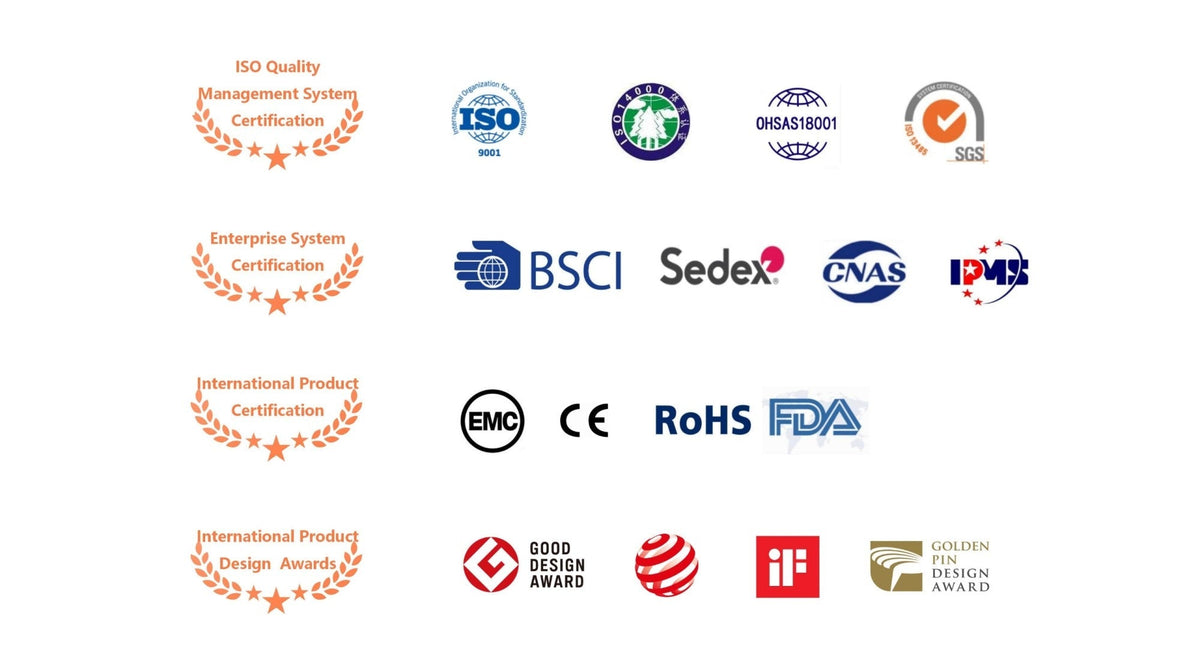
TOUCHBeauty’s company materials identify ISO 9001, ISO 13485, ISO 14001 and ISO 45001 within its management and manufacturing framework. Each covers a different aspect of organizational practice. Certificate scope, site, legal entity, edition and validity should be checked against the applicable certificate before relying on a specific certification claim.
| Standard | Focus | What it does not establish |
|---|---|---|
| ISO 9001 | General quality management | Individual product efficacy |
| ISO 13485 | Medical device quality management | Clearance of every device |
| ISO 14001 | Environmental management | A zero-impact product |
| ISO 45001 | Occupational health and safety | Individual consumer suitability |
These systems are relevant because consistent processes and documented responsibilities matter throughout a product's life cycle. A system certification is not a clinical trial, however, and does not make every product a medical device or establish that every user will experience the same outcome. ISO develops standards; certification is performed by certification bodies, not ISO itself.
Learn more from ISO's management system overview and its certification guidance.
Laboratory Testing and CNAS Accreditation
TOUCHBeauty reports operating a CNAS-accredited laboratory. CNAS stands for China National Accreditation Service for Conformity Assessment. Laboratory accreditation concerns competence for activities within an identified scope, rather than a blanket endorsement of every product made by a company.
For a beauty device, relevant tests can include electrical characteristics, mechanical durability, temperature behavior, light output, material compatibility or resistance to water where claimed. Which tests are appropriate depends on the product design, intended use and applicable requirements. These are examples of testing areas, not a statement that our laboratory is accredited for every one of them.
A laboratory's accreditation schedule is the appropriate place to check specific methods and capabilities. For additional context, see CNAS laboratory accreditation criteria.
Product Compliance Across Different Markets
Beauty devices sold internationally may be subject to different requirements according to their intended purpose, electrical design, power supply and product classification. TOUCHBeauty's company materials identify product-specific documentation including CCC (3C), CE-related electrical safety and electromagnetic compatibility information, RoHS, REACH, quality inspection reports and FDA-related records where applicable.
| Market | Examples to evaluate |
|---|---|
| United States | FDA pathway where applicable; other product-specific requirements |
| European Union | Applicable CE legislation, RoHS and REACH obligations |
| Japan | PSE for covered electrical products; applicable local requirements |
| China | CCC for covered products and other applicable requirements |
CE marking is a manufacturer's declaration that applicable EU requirements for CE marking are met. Depending on the legislation, third-party conformity assessment may also be necessary. RoHS restrictions and REACH obligations address different aspects of substances and materials; neither is a clinical efficacy credential. In Japan, the Electrical Appliances and Materials Safety Act and PSE marking apply to covered electrical products, not automatically to every beauty device.
For business customers, the appropriate documentation should be matched to the destination market, model, accessories and intended claims before purchasing or distributing a product. Sales in a particular country are not by themselves evidence of compliance with every requirement in that market.
See the European Commission's CE marking guidance and Japan's METI electrical product safety guidance.
What Does FDA Clearance Mean for TOUCHBeauty Devices?
Some devices have public U.S. FDA 510(k) records. Clearance through this pathway concerns a determination of substantial equivalence for the device and specified use. It is not the same as premarket approval, establishment registration or device listing. The distinction becomes particularly important when a multifunction device has different modes or treatment attachments.
GLAM LED Facial Mask
The public record K251727 identifies model TB-2386F. Its red and yellow modes cover wrinkle treatment (red for the full face), while its blue mode covers mild-to-moderate inflammatory acne. These indications do not automatically extend to pigmentation, oil reduction or unrelated skin conditions.
VITA Multi-Function Head Brush
There are separate public records for specific VITA models and intended uses. K252053 concerns defined pattern hair loss populations in head mode and specified facial LED applications in face mode. K260179 concerns facial microcurrent for cosmetic use. The latter is not a clearance for scalp microcurrent hair regrowth.
| Public record | Named models | Scope in brief |
|---|---|---|
| K251727 (Aug 29, 2025) | TB-2386F | Wrinkles; mild-to-moderate inflammatory acne, by mode |
| K252053 (Oct 27, 2025) | TB-2443F, TB-2442AF, TB-2343F, TB-2442F | Head: specified androgenetic alopecia classifications, Fitzpatrick I–IV. Face: LED for full-face wrinkles and/or mild-to-moderate inflammatory acne. |
| K260179 (Jun 3, 2026) | TB-2343F, TB-2442F | Facial cosmetic microcurrent only |
Model matching matters: the records above name regulatory models, not every retail SKU sold under the GLAM or VITA families. Confirm the model identifier, treatment attachment and instructions before applying a clearance to a product. Do not extrapolate a clearance from one model, market or mode to another.
For the terminology, consult the FDA's 510(k) information and its registration and listing guidance.
How Third-Party Performance Testing Adds Context
Performance testing answers a different question from market access: what happened when a sample was evaluated using a defined method? Selected TOUCHBeauty products have undergone third-party evaluation. For example, the VITA Multi-Function Hair Care Comb was evaluated by SGS-CSTC Standards Technical Services Co., Ltd., Guangzhou Branch, in report GZCPCH24005312-01_EN dated November 28, 2024.
The evaluation involved 32 Asian adults aged 25–52 over 56 days. The protocol incorporated approximately five minutes of daily use of the ALL-IN-ONE mode with a collagen moisturizing scalp essence. The report recorded changes in scalp sebum and hair-related measurements, including a 30.65% decrease in measured scalp sebum and a 47.38% decrease in hair shedding counts using a standardized 60-stroke combing method at day 56 compared with baseline.
These findings describe the combined routine, not the isolated effect of a particular wavelength, ion generator or microcurrent mode. The evaluation did not include a separate sham or comb-only comparison group. It should not be read as a medical-device clinical trial, an SGS product certification or a promise of individual results. The report itself limits its findings to the submitted sample and evaluation conditions.
When comparing a headline percentage on a beauty device, look for the sample size, time period, baseline, measurement method and whether other products were used. A number is more useful when its context is available.
Industry Standards and Product Development
TOUCHBeauty's company information describes participation in standards development for photon beauty devices, ultrasonic pore cleansers, hair dryers, electric toothbrushes, hair-care appliances and LED light sources for home beauty equipment. Standards work helps translate technical requirements into common language and measurable test methods. It is separate from the verification of compliance for a particular manufactured product.
Participation in design awards, patent applications and standards development provides insight into a company's technical background. It is not a substitute for checking a product's electrical safety, intended use or performance evidence.
Responsible Manufacturing and Social Responsibility
Our company materials also identify amfori BSCI and Sedex-related social responsibility systems and audits. These relate to responsible business and supply-chain practices. They should not be described as product safety certificates or guarantees of beauty outcomes. Audit scope, site and date matter when evaluating these documents.
For retail and distribution partners, quality information may include management certificates, applicable declarations of conformity, sample test reports, labeling, instructions and after-sales information. We recommend reviewing the relevant records for the intended market rather than treating a general brand credentials list as a complete compliance package.
How to Choose and Use Beauty Devices Responsibly
Start with your actual care goal and choose a device designed for that purpose. Check the model printed on the device or packaging, read its instructions and pay attention to recommended session frequency, cleaning, charging and precautions. A higher intensity or longer session is not necessarily better.
- For LED masks, check eye-protection instructions and photosensitivity precautions.
- For electrical stimulation tools, check contraindications, including implanted electronic devices, and seek professional advice where needed.
- For heated tools, check temperature guidance and avoid prolonged contact.
- For washable attachments, distinguish the water resistance of the attachment from that of the main device.
- Stop using a device if it develops unusual heat, damage, pain or persistent irritation; contact support for guidance.
For questions about a specific product, use our contact page or consult the TOUCHBeauty FAQs. Check the product's own warranty and applicable return policy rather than assuming that the same warranty applies to every market or item.
Frequently Asked Questions
Is TOUCHBeauty a reliable beauty device brand?
TOUCHBeauty has developed personal care devices since 1999 and combines design, research, manufacturing and testing in its company framework. For a purchase decision, consider the evidence and documentation available for the particular model and care goal.
Are all TOUCHBeauty devices FDA cleared?
No. Public 510(k) records apply to named devices and specified uses. Not all beauty devices require the same regulatory pathway.
What is the difference between ISO certification and FDA clearance?
ISO management system certification applies to a defined organizational scope. FDA 510(k) clearance concerns a named device and its intended use in the United States.
Is CNAS accreditation a product certificate?
No. It concerns laboratory competence for activities covered by the accreditation scope.
Does SGS testing guarantee results?
No. A report describes results obtained under particular conditions with specified samples and methods. Individual outcomes may differ.
Does CE marking mean a device is clinically proven?
No. CE marking indicates conformity with applicable EU legislation; it does not by itself establish every advertised cosmetic benefit.
Are BSCI and Sedex product safety certifications?
No. They concern responsible sourcing and social compliance tools or audits, rather than product-specific safety or efficacy.
How can I check documentation for my device?
Identify the exact model and market, then contact TOUCHBeauty with the requested document type. Regulatory records and applicable instructions should correspond to that model and use.
Explore TOUCHBeauty with Confidence
We believe quality information should help you choose a device, understand its intended purpose and use it responsibly. Discover more about TOUCHBeauty, or explore our range of personal care tools.
Find the right device for your routine.

Leave a comment
All comments are moderated before being published.
This site is protected by hCaptcha and the hCaptcha Privacy Policy and Terms of Service apply.