



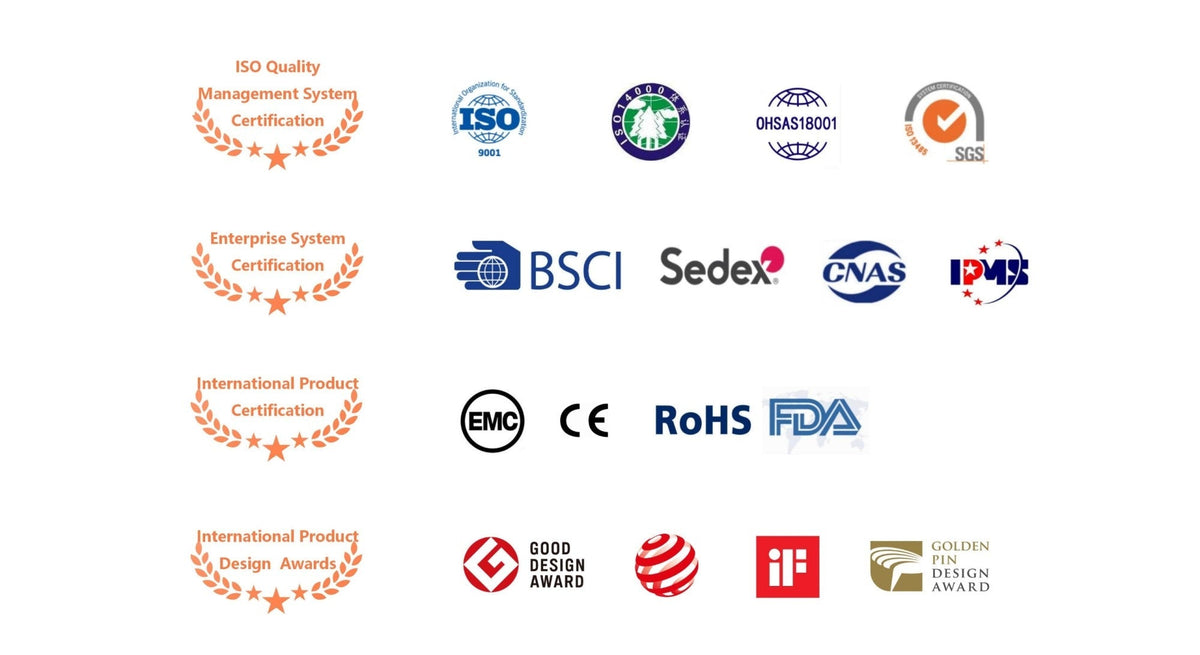
TOUCHBeauty is a beauty and personal care technology brand founded in 1999. Its approach to product innovation combines industrial design, in-house research and development, manufacturing and participation in technical standards. The company reports more than 300 patent applications, alongside recognition from international design award programs. These achievements reflect different aspects of product development, rather than a single measure of skincare effectiveness.
What makes a beauty device well designed? It is not simply a beautiful finish or a long list of features. A useful device must connect technology with a real everyday need, be comfortable to handle and provide clear instructions for its intended use. This is the thinking behind TOUCHBeauty’s approach to beauty technology.
From Everyday Needs to Beauty Technology
Our development journey began with heated eyelash care in 1999. Since then, TOUCHBeauty has expanded its research into facial cleansing, optical makeup mirrors, light-based beauty devices and hair and scalp care. Across these categories, the challenge remains the same: how can a technology be translated into a practical tool that people can incorporate into their routines?
Our approach brings together product definition, engineering, industrial design and manufacturing. A product concept must account for the intended user, contact with the skin or hair, power requirements, controls, maintenance and the environments where it will be used. Different applications call for different design decisions.
Explore the origins of this approach in the TOUCHBeauty brand story.
Which International Design Awards Has TOUCHBeauty Received?
TOUCHBeauty’s brand records identify recognition from the Red Dot Award, iF Design Award, Japan Good Design Award and Taiwan Golden Pin Design Award, among others. Selected examples can also be found in the public award organizers’ archives. Design recognition is especially meaningful when it connects an object's form with the way it is handled and operated.
Red Dot Award: Ultrasonic Scrub Device
The Red Dot Product Design 2021 archive identifies TOUCHBeauty’s Ultrasonic Scrub Device as an awarded product. The entry credits the Shenzhen manufacturer and in-house design. Its design brings a shaped treatment tip, flowing body contours and touch-operated controls into one handheld device.
Known in TOUCHBeauty’s brand materials as GLOW, the device illustrates how a technical feature such as an ultrasonic treatment surface can be integrated with an approachable physical design. The award recognizes the design of the submitted product; it does not independently establish a clinical outcome for every ultrasonic device or later product version.
iF Design Award: Advanced Electric Facial Cleanser
The iF Design archive features an Advanced Electric Facial Cleanser developed by TOUCHBeauty Beauty & Health (Shenzhen) Co., Ltd. The entry describes a portable dual-mode cleansing device with customizable operation and a restrained pearl-white finish.
The company’s technical records identify the TB-1760 dual-action cleanser as an example of this approach. Rotational and oscillating movements offer different forms of mechanical cleansing, while adjustable intensity gives the user more control over the experience. The award is a recognition of design, not a guarantee that a cleansing brush is suitable for every skin type.
iF Design Award: Eye Beauty Device
The official iF company profile also lists an awarded Eye Beauty Device. Together, these entries show how the brand has applied design thinking to distinct personal care needs rather than relying on a single product format.
Japan Good Design Award and Other Recognition
TOUCHBeauty’s historical brand materials report that the GLOW ultrasonic device received Japan’s Good Design Award in 2017. The company also identifies Golden Pin Design recognition in its corporate records. These are company-reported examples; individual award details should be read against the corresponding award records.
Why Product Design Matters Beyond Appearance
Industrial design is often first noticed through color, shape and materials. In personal care technology, however, the way a product feels and functions can be just as important as how it looks. A comfortable grip, clear mode indicators and accessible cleaning features can all influence whether a device becomes part of a regular routine.
Our design philosophy emphasizes practical use, portability, visual refinement and safety-conscious engineering. The appropriate balance differs by product. A makeup mirror needs useful lighting and viewing angles, while a scalp comb needs manageable contact with hair and scalp. A facial cleansing brush requires attention to pressure, movement and skin tolerance.
What Do More Than 300 Patent Applications Mean?
According to TOUCHBeauty’s current corporate information, the company has filed more than 300 patent applications across domestic and international jurisdictions. This number refers to applications, not necessarily granted, active or individually distinct patents.
Patents are one way to document and protect technical or design developments. Depending on the jurisdiction, intellectual property may cover a functional mechanism, a structural solution or an ornamental design. An application may be pending, granted, withdrawn or expired. A patent record is not proof that a product achieves a particular health or beauty result.
Examples of publicly accessible patent records
Public patent publications provide concrete examples of engineering and design activity associated with TOUCHBeauty’s manufacturing entity. They can be explored by publication number, applicant or assignee, and jurisdiction.
| Publication | Type | Example |
|---|---|---|
| USD886375S1 | US design patent | Heated eyelash curler |
| CN222443409U | Chinese utility model publication | Hair comb structure intended to assist detangling |
These records illustrate different forms of intellectual property. Neither record establishes that every current retail model implements the same protected features, and the legal status of a patent may change over time.
From Prototypes to Products: How Innovation Continues
TOUCHBeauty’s development model connects research, product planning, internal manufacturing, participation in standards, market feedback and further iteration. Instead of treating innovation as a one-time launch, this model allows product ideas to be refined through repeated development cycles.
Research and product definition
The starting point is identifying a care need and selecting technology appropriate for the intended application. Light, electrical stimulation, mechanical movement and controlled heat serve different purposes and require different engineering approaches.
Industrial design and engineering
Product development turns a concept into a usable form. The shape of a treatment head, the placement of a control, charging arrangements and intensity options all affect how a user interacts with a device. Engineering must address the relevant technical requirements as well as the design brief.
Manufacturing, evaluation and iteration
Integrated manufacturing supports communication between development and production teams. Product evaluation and market feedback can then inform improvements in usability, reliability and maintenance. Testing should be selected to match the product’s intended function, not applied as a blanket claim across unrelated devices.
Why TOUCHBeauty Participates in Industry Standards
Standards help translate technical knowledge into shared requirements and repeatable testing methods. TOUCHBeauty’s corporate records describe involvement in standards for home-use light-based beauty devices, ultrasonic pore cleansing, hair dryers, hair-care equipment, electric toothbrushes and LED light sources.
Two publicly accessible Chinese national standards provide specific examples. The official drafting lists include the Chinese legal entity name 渲美美健(深圳)科技股份有限公司 associated with TOUCHBeauty’s corporate records.
| Standard | Subject | Effective date |
|---|---|---|
| GB/T 4706.118-2024 | Safety requirements for skin beauty care appliances | August 1, 2026 |
| GB/T 23106-2024 | Performance measurement methods for electrical hair-care appliances | April 1, 2025 |
The first standard addresses safety requirements for skin beauty appliances. The second describes methods for measuring the performance of electrical hair-care appliances. Both are listed as current recommended national standards in the official database. Participation means contributing to collaborative work; it does not mean a company owns the standard or that every product automatically conforms to it.
How TOUCHBeauty Applies Technology Across Product Categories
Our research has developed across different forms of personal care rather than focusing only on one bestseller. Selected examples illustrate the connection between technical development and everyday use.
| Category | Technology example | Design focus |
|---|---|---|
| Heated eyelash care | Controlled heating | Contact design and temperature control |
| Facial cleansing | Rotation and oscillation | Adjustable movement and pressure |
| LED makeup mirrors | Light-guide structures and intelligent sensing in selected models | Lighting and viewing convenience |
| LED facial care | Visible LED wavelengths | Fit, mode selection and eye-protection instructions |
| Hair and scalp care | Ions, sonic vibration and selected electrical or light-based features | Scalp contact, handling and routine integration |
Each device has a separate intended use, instructions and evidence profile. For a closer look at scalp technology, explore the VITA Scalp Care Comb. For facial light-based care, see the GLAM LED Mask. Product availability and specifications can vary by market.
Design Awards, Patents and Product Evidence Are Different
A design award can help consumers understand the thinking behind a product. A patent can document a technical or design development. Standards participation can indicate experience with technical requirements. None of these should be confused with a product-specific efficacy evaluation.
| Evidence type | What it can show | What it does not establish |
|---|---|---|
| Design award | Recognition of a submitted design | Clinical efficacy |
| Patent record | Published technical or ornamental development | Guaranteed outcome or product quality |
| Standards drafting | Participation in shared technical requirements | Automatic conformity of every model |
| Regulatory documentation | Specific regulatory status and scope | Universal product approval |
| Product testing | Results for defined methods and conditions | Identical results for all users or devices |
TOUCHBeauty reports operating a CNAS-accredited laboratory and maintaining manufacturing quality systems. Selected devices also have relevant regulatory documentation or third-party evaluations. For a purchase decision, the applicable document, exact model, intended use and test conditions matter more than the number of logos displayed on a page.
How to Choose a Beauty Device with Confidence
Start with the care goal rather than the number of modes or awards. Review the device’s instructions, maintenance requirements and any precautions relevant to you. If an advertised outcome is particularly important, look for evidence tied to the exact device or technology, and check whether the source measured that outcome directly.
A thoughtful purchase is one that fits your needs, budget and routine. A simple tool can be more useful than a multifunction device if you only need one function. Read our beginner’s beauty device buying guide for a step-by-step approach.
Frequently Asked Questions
Has TOUCHBeauty won international design awards?
Yes. Public Red Dot and iF archives identify awarded TOUCHBeauty products, and the brand reports further recognition including Japan Good Design and Golden Pin Design awards.
Which TOUCHBeauty products have received design recognition?
Public award entries include the Ultrasonic Scrub Device, Advanced Electric Facial Cleanser and Eye Beauty Device. Consult the original entry for the specific submitted design.
How many patents does TOUCHBeauty have?
The company reports more than 300 domestic and international patent applications. This is an application count, not a verified count of granted or currently enforceable patents.
Does a design award mean a beauty device is clinically proven?
No. Design recognition and clinical evidence serve different purposes. A product’s measurable effects require appropriate evidence for the specific claim.
Does TOUCHBeauty develop its own products?
According to its corporate information, TOUCHBeauty integrates product design, research and development, manufacturing and global operations. It has also worked with external designers over its history.
Does TOUCHBeauty participate in national standards?
Yes. Official Chinese national standard records list 渲美美健(深圳)科技股份有限公司 among the drafting organizations for GB/T 4706.118-2024 and GB/T 23106-2024.
Does standards participation certify every TOUCHBeauty product?
No. Contributing to standards development does not establish conformity for every device. Product-specific documentation remains necessary.
Where can I find more information about TOUCHBeauty?
Visit our About Us page for company information, and check the product page and instructions for the device you are considering.
Discover the Thinking Behind TOUCHBeauty
From the early heated eyelash curler to modern scalp care and facial beauty devices, TOUCHBeauty’s development reflects a continuing effort to make personal care technology practical, considered and approachable. Design recognition, intellectual property and standards work are parts of that journey; the next step is turning that work into products that fit real routines.
Explore beauty technology designed for everyday routines.
Learn more about our brand and discover the devices that fit your personal care goals.


Leave a comment
All comments are moderated before being published.
This site is protected by hCaptcha and the hCaptcha Privacy Policy and Terms of Service apply.