



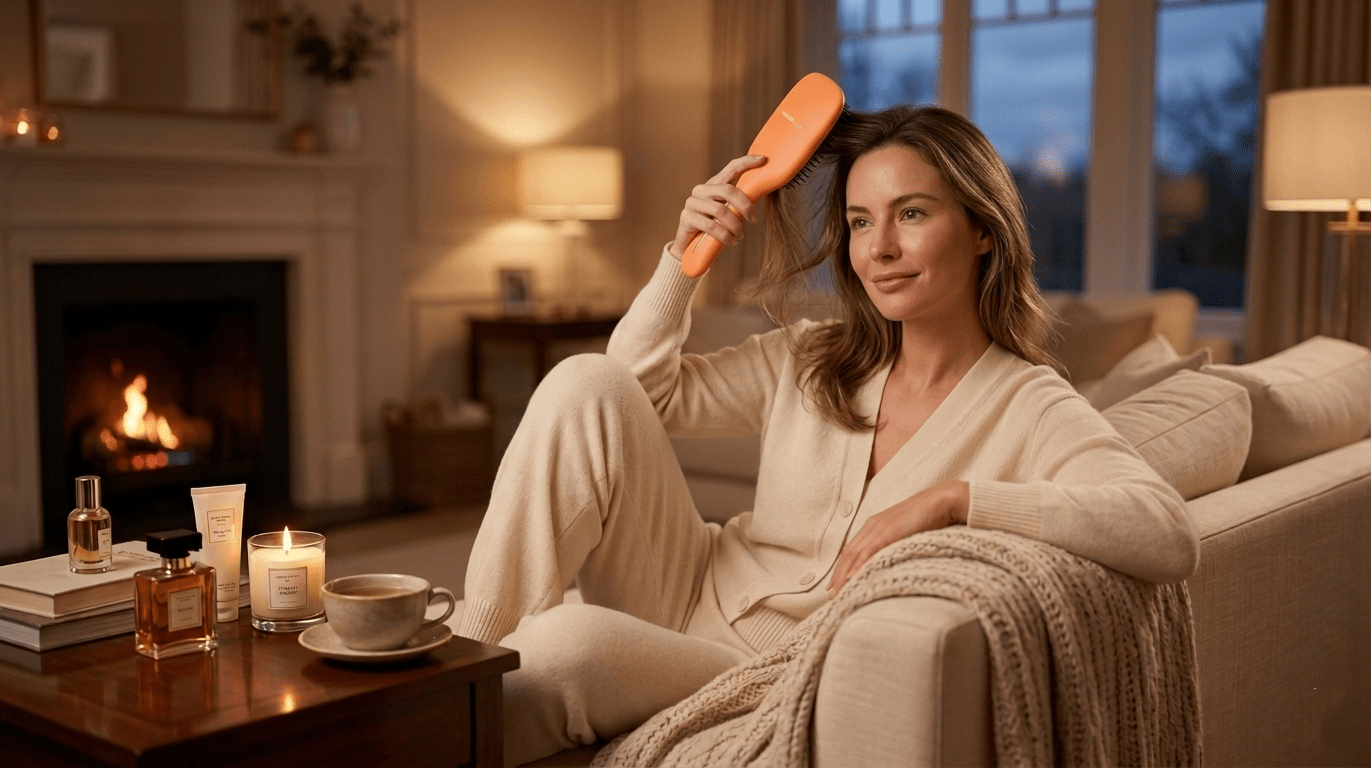
What is EMS scalp therapy—and can it really improve hair growth? EMS (electrical muscle stimulation) uses controlled electrical pulses delivered through conductive contact points. In a scalp care device, it can create an additional stimulation experience beyond ordinary brushing or mechanical massage. However, EMS is not interchangeable with red light therapy, and evidence from one electrical-stimulation device cannot automatically be applied to another.
If you are comparing an EMS scalp massager with a regular brush, this guide explains the technology, what users may feel, how it differs from other hair-care tools, and why product-specific evidence matters.
For everyday cleansing, brushing and comfort basics, start with our complete at-home scalp care guide.

What Is EMS Scalp Therapy?
EMS stands for electrical muscle stimulation. In its conventional medical and exercise applications, EMS delivers electrical pulses to stimulate nerves and muscle tissue. The term is also used in consumer beauty marketing, but products can differ markedly in their waveform, strength, electrode design and intended purpose.
When you see terms such as EMS scalp therapy, scalp microcurrent or electric scalp massager, do not assume they all describe the same intervention. Check the product manual and published device specifications rather than treating the marketing terms as clinical classifications.
Quick answer: an electrical scalp comb adds pulses through conductive contact points; a regular scalp brush relies on mechanical movement. Either may fit a self-care routine, but a pleasant sensation is not, on its own, evidence of hair regrowth.
What might EMS feel like on the scalp?
Depending on intensity, contact and individual sensitivity, users may notice mild tingling, pulses or little sensation at all. More discomfort does not mean greater effectiveness. Use the appropriate settings for your model and stop if stimulation feels unpleasant.
How Does an EMS Scalp Device Work?
Electrical scalp devices use electrodes or conductive points that make contact with the scalp and deliver pulses according to a device-specific electrical design. Variables that can affect the experience include waveform, amplitude, pulse duration, electrode contact and use time. These variables are not established by the label “EMS” alone.
Electrical contact is different from mechanical massage
During manual massage, fingers or brush teeth move the skin mechanically. With an electrical device, stimulation is delivered through contact points, sometimes alongside brushing or vibration. These different mechanisms may feel different, but they should not be described as equivalent to a proven medical treatment.
Why device-specific evidence matters
A proposed biological mechanism—such as electrical signaling within tissue—is only a starting point. Demonstrating a measurable benefit requires evaluation of the specific device and protocol. A study of a 30-minute wearable device cannot validate a five-minute handheld comb without separate testing.
If your goal is to understand the full routine surrounding an electric comb, our at-home scalp care guide covers cleansing, drying and comfortable brushing.

EMS vs. Traditional Scalp Massage: What's the Difference?
A manual scalp massager uses direct mechanical movement. An EMS device adds electrical stimulation, which may or may not be accompanied by vibration or brushing. Neither method is universally better.
| Feature | Manual scalp massage | EMS/electrical scalp device |
|---|---|---|
| Main method | Finger or brush pressure and movement | Electrical pulses through scalp contact points |
| Power required | No | Yes |
| Typical experience | Physical pressure or brushing | May include tingling or pulses; sensation varies |
| Product evidence | Depends on proposed benefit | Depends on exact electrical technology and model |
| Best reason to choose | Simple massage and routine comfort | Preference for an electronic stimulation feature |
If your main question is whether a scalp massager is worthwhile, see Is a Scalp Massager Good for You?. That guide focuses on everyday massage; this article focuses on electrical stimulation.
What Are the Potential Benefits—and Limits—of EMS Scalp Care?
1. A different scalp-care sensation
Electrical stimulation adds an experience that ordinary mechanical massage does not provide. Some people enjoy the sensation as part of a regular self-care ritual; individual comfort varies.
2. An integrated routine in a multifunctional device
Combining electrical stimulation with brushing, vibration or other technology may reduce the number of tools needed. Convenience is a product benefit, not a clinical efficacy claim.
3. A way to personalise an at-home routine
A device with selectable modes can let users choose different features according to the manual and their comfort. The most appropriate mode is not necessarily the strongest one.
4. Interest in emerging electrical-stimulation research
Researchers have studied particular low-level electrical stimulation and electrotrichogenesis systems for hair-related outcomes. That does not mean that all consumer EMS scalp devices have equivalent performance.
What remains unproven about EMS as a standalone VITA feature?
Available SGS VITA evaluation data concern a combined whole-device regimen; they do not isolate the independent contribution of EMS. Therefore, it would be inaccurate to say that VITA EMS alone has been shown to regrow hair, treat dandruff, control oil or reverse a hair-loss condition.

EMS, Microcurrent and Red Light: Are They the Same?
No. They describe different categories or parameters of device operation.
| Term | What it describes | What to check |
|---|---|---|
| EMS | Electrical impulses used for stimulation | Waveform, intensity, contact method and instructions |
| Microcurrent | Very low electrical current; exact specifications vary | Actual current parameters and stated use |
| Red LED | Light produced by light-emitting diodes | Wavelength, exposure and model-specific evidence |
| Low-level laser | Light delivered through laser diodes | Wavelength, dose, application and tested device |
Read our LLLT beginner's guide for laser-versus-LED definitions, or Do Laser Hair Growth Combs Work? for clinical research into specific light-based products.

What Does Research Say About Electrical Stimulation for Hair?
Some controlled research supports the potential of specific electrical-stimulation systems for certain hair-loss outcomes. But the results need to be read alongside the studied device, patient group, schedule and design—not borrowed as proof for unrelated consumer EMS combs.
2026 sham-controlled trial: niostem wearable electrotrichogenesis
A 2026 randomised, double-blind, sham-controlled study investigated a niostem wearable electrotrichogenic (ETG) device in 81 men aged 18–55 with androgenetic alopecia. Participants were assigned to active or sham treatment for 30 minutes daily over 24 weeks.
At six months, the active group showed a greater increase than sham in total hair density (between-group difference 24.40 hairs/cm²; p=0.02) and terminal hair density (17.06 hairs/cm²; p=0.02). The study was conducted on niostem, not TOUCHBeauty VITA. Several authors had manufacturer affiliations or interests, which should be considered when interpreting the evidence.
2025 pilot study: promising but less conclusive
A 2025 pilot study followed 21 men using the niostem system for 30 minutes a day over six months. It reported improvements in measured hair outcomes, but without a sham control group, the design was less able to rule out other explanations.
What these studies mean for a buyer
The two papers suggest that some specific low-level electrical-stimulation systems warrant further investigation. They do not demonstrate a class-wide effect for every device marketed as EMS, nor do they test the electrical output or EMS-only performance of the VITA TB-2343. If you see a growth percentage in an advertisement, ask which product, which measurement, which control group and which treatment protocol produced it.
Who Might Consider an Electric Scalp Massager?
An electric scalp massager may interest people who want a tech-enabled self-care experience, enjoy scalp massage, or prefer a multifunctional hair-care tool. It should be chosen for features that are relevant to the user, not because a device claims to cure hair loss.
For sudden shedding, patchy loss, inflamed or painful scalp skin, persistent itching, or other concerning symptoms, seek a qualified healthcare professional rather than relying on an at-home beauty device.

How to Use a Scalp Care Device With EMS
- Check the device and contraindications. Read the manual for your exact model, including implanted-device warnings and restricted-use conditions.
- Prepare the scalp as directed. For the consumer-facing TOUCHBeauty VITA TB-2343, the current product guidance recommends clean, completely dry hair and scalp for ordinary use.
- Select the appropriate mode and intensity. Start with a comfortable setting. Do not assume stronger pulses work better.
- Maintain gentle contact. Move the comb slowly without scratching or pressing forcefully.
- Observe the recommended duration and frequency. Follow the published manual for your exact variant. Do not copy a research study's 30-minute wearable protocol into a handheld device routine.
- Stop if uncomfortable. Avoid broken or inflamed skin and seek appropriate professional advice for persistent symptoms.
Important: the SGS evaluation protocol for VITA used a specific once-daily, approximately five-minute ALL-IN-ONE routine together with collagen moisturising scalp essence. That protocol describes how the evaluation was conducted; it is not a substitute for the consumer manual and should not be interpreted as authorising wet operation or unapproved products with electrical stimulation.
Meet TOUCHBeauty VITA: EMS Plus Multi-Function Hair Care
The TOUCHBeauty VITA Scalp Care Comb (TB-2343) is a multi-function scalp and hair care device combining electrical stimulation with sonic vibration, negative-ion care, blue light and red/low-level light functions. It is an example of a product integrating EMS; this article is not intended to turn research about third-party electrical devices into a claim for VITA EMS.
VITA's four modes at a glance
| Mode | Main features | How to think about it |
|---|---|---|
| MASSAGE+ | Sonic vibration and ionic care | Everyday grooming and comfortable massage |
| OIL-CONTROL+ | Blue LED, EMS and vibration | Scalp-focused care setting |
| REVITALIZE+ | Red/low-level light and EMS | Light-based care setting; distinct from EMS-only research |
| ALL-IN-ONE | Integrated multiple functions | Combined care routine used in the SGS evaluation |
What the SGS 56-day VITA evaluation actually found
SGS-CSTC Standards Technical Services Co., Ltd. Guangzhou Branch issued Evaluation Report GZCPCH24005312-01_EN on November 28, 2024 for the VITA Multi-Function Hair Care Comb. The report covered 32 Asian adults aged 25–52 with valid data over 56 days.
Under the protocol—daily use of the device in ALL-IN-ONE mode, at the recommended third level, for about five minutes, together with collagen moisturising scalp essence—the report recorded the following Day 56 changes versus baseline:
- 30.65% decrease in instrument-measured scalp sebum content;
- 5.01% increase in imaging-assessed local hair density;
- 5.21% increase in imaging-assessed local hair count;
- 47.38% decrease in hair counts observed using a standardised 60-stroke combing method.
Source: SGS Evaluation Report GZCPCH24005312-01_EN, pp. 7–10, 19, 22, 25 and 27. The SGS report states that results relate to the submitted sample and that it is not a medical-device clinical trial conducted by SGS.
How to interpret these numbers: they are outcomes recorded for the evaluated combined regimen. The report does not present a separate EMS-off or sham-device control group, and the routine included a topical essence. Thus, the data cannot determine the independent effect of VITA's EMS feature or promise that a new customer will see the same result.
Explore EMS as Part of VITA's Full Routine
Compare the four care modes, learn about the available functions, and review practical usage instructions on the product page.
Common Mistakes When Evaluating EMS Scalp Devices
- Assuming every electrical treatment is identical. EMS, microcurrent and electrotrichogenesis may involve different electrical parameters.
- Borrowing another brand's clinical results. Research on a wearable ETG device is not direct evidence for VITA.
- Using a device contrary to its instructions. Dry-only devices should not be used with shampoo or water.
- Believing stronger stimulation means better outcomes. Discomfort is not a measure of effectiveness.
- Expecting a cure for hair loss. Medical symptoms and significant hair shedding require proper evaluation.

Frequently Asked Questions About EMS Scalp Therapy
What is EMS scalp therapy?
It is the use of electrical-stimulation features in a scalp-care device. Different devices may deliver different types and strengths of electrical pulses.
Is EMS the same as microcurrent scalp therapy?
Not necessarily. Microcurrent refers to a low current level, while EMS describes stimulation; consumer terms can overlap. Check the actual device specifications.
Does the SGS VITA study prove that EMS alone works?
No. The 2024 SGS evaluation reported changes after a 56-day routine that combined the VITA ALL-IN-ONE mode with a collagen moisturising scalp essence. Without an EMS-only comparison, those outcomes cannot be attributed to the electrical-stimulation feature by itself.
Can EMS scalp therapy grow hair?
Selected low-level electrical stimulation systems have been studied for certain hair-loss outcomes. However, the 2026 controlled trial was conducted on a specific niostem wearable, not on TB-2343. It does not establish that all EMS scalp tools regrow hair or that the VITA EMS mode alone produces those results.
Is EMS better than manual scalp massage?
Neither is universally better. Manual massage provides physical movement; EMS adds an electrical-stimulation feature. Choose based on comfort, device instructions and evidence relevant to your goal.
Can I use TOUCHBeauty VITA on wet hair?
No. VITA is designed for use on clean, completely dry hair and scalp.
How often can I use the EMS feature on VITA?
Follow the instructions for your specific model. The current VITA product guide describes targeted scalp modes generally for three to five sessions per week; the SGS evaluation used a separate, supervised-style once-daily combined regimen. Study usage is not a replacement for the retail manual.
When should I avoid an electrical scalp device?
Follow the manufacturer's contraindications. Avoid application over damaged or inflamed skin and seek professional advice if you have an implanted electrical device, a relevant medical condition or uncertainty about suitability.

Final Takeaway
EMS scalp therapy is best understood as an electrical-stimulation feature within some modern scalp-care products, not a proven cure for hair loss. For a buyer, the useful questions are how a device works, how it feels, whether the instructions fit their routine, and what evidence supports the exact model.
For the broader routine, visit our Complete Scalp Care Guide. For a product example, see the TOUCHBeauty VITA Scalp Care Comb.
Research References
- Chacón-Martínez CA, et al. Efficacy, Safety, and Tolerability of a Wearable Electrotrichogenic Device in Men with Androgenetic Alopecia: A Randomized, Double-Blind, Sham-Controlled Trial. Dermatology and Therapy, 2026. PubMed PMID 42018094. Studied niostem, not VITA.
- Jellard S, et al. Novel Electrotrichogenic Device Promotes Hair Growth in Men With Androgenetic Alopecia: A Pilot Study. Journal of Cosmetic Dermatology, 2025. PubMed PMID 40296533. Studied niostem, not VITA.
- SGS-CSTC Standards Technical Services Co., Ltd., Guangzhou Branch. Evaluation Report GZCPCH24005312-01_EN, November 28, 2024, 36 pages. Tested a VITA combined routine, not the isolated EMS function. This report was supplied by TOUCHBeauty for editorial verification; a public report URL is not provided here.
Editorial transparency: this article distinguishes general research on electrical stimulation, manufacturer-provided product functions, and the SGS whole-device evaluation. It does not claim that an EMS feature on its own has an established medical benefit for hair loss.


Leave a comment
This site is protected by hCaptcha and the hCaptcha Privacy Policy and Terms of Service apply.