



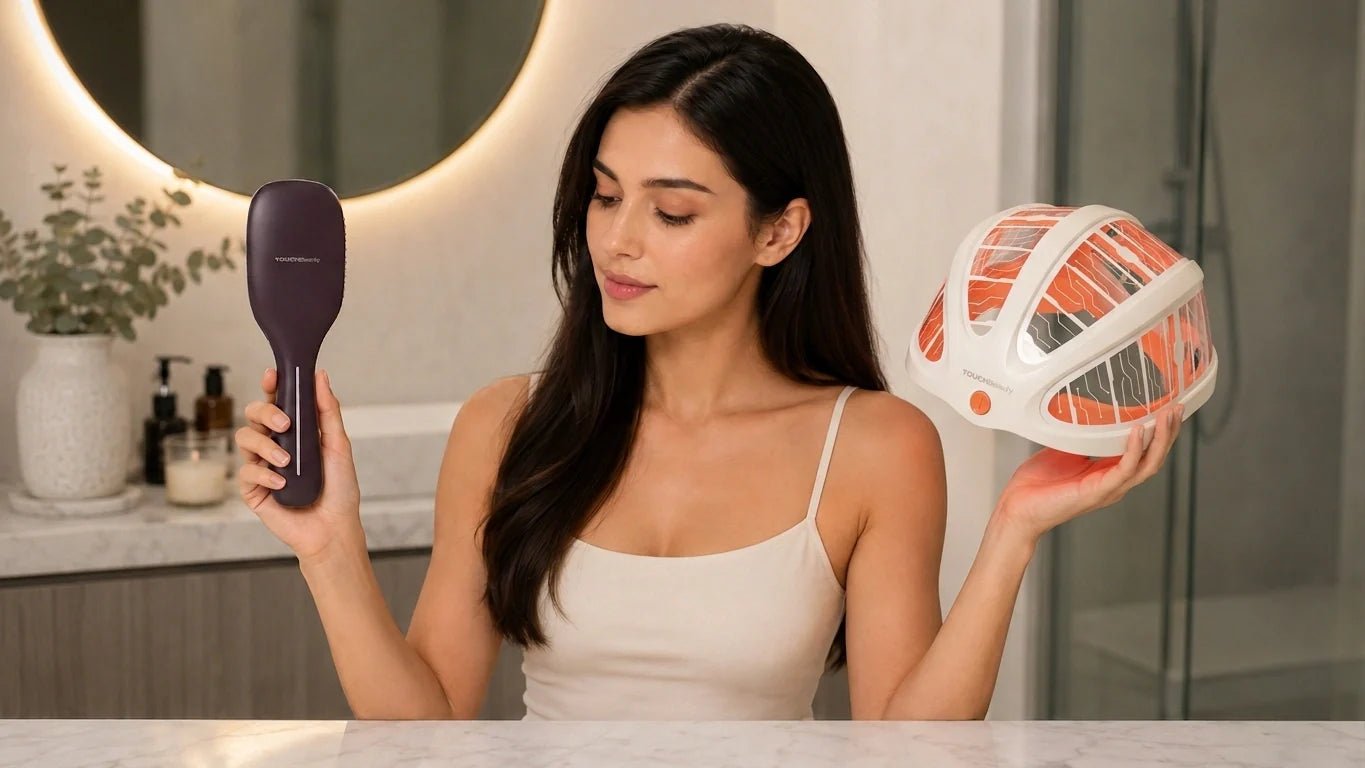
What is low-level laser therapy for hair? Low-level laser therapy (LLLT) uses controlled, relatively low-power light in an approach also known as photobiomodulation. Certain devices have been studied for pattern hair loss, but results depend on the device, diagnosis and treatment schedule. LLLT is not a guaranteed cure for every form of hair thinning.
If you are new to low-level laser therapy for hair, this guide explains the key terms, the difference between laser and LED light, the information to check on a product label and the safety questions to ask before starting a routine. For a deeper review of clinical trials and whether a particular laser comb may work, read Do Laser Hair Growth Combs Work? What Research Says.

What Is Low-Level Laser Therapy (LLLT)?
LLLT is a non-invasive approach that exposes tissue to specific light wavelengths at relatively low power. In hair research, it is primarily studied in people with androgenetic alopecia (male or female pattern hair loss). Devices sold for home use may take the form of handheld combs, caps or helmets.
Photobiomodulation is the broader term researchers use for light-driven biological responses. Depending on the context, the term may include both laser and LED sources. Product labels such as “laser therapy,” “red light” and “hair growth comb” should not be assumed to describe the same specifications or evidence.
These devices are not equivalent to high-energy surgical or cosmetic resurfacing lasers. Nevertheless, “low-level” does not mean every device is suitable for every user, so its safety instructions still matter.

How Does LLLT Work on the Scalp?
The proposed mechanism involves absorption of light by components within cells, potentially influencing signaling pathways associated with cellular activity. Researchers are still studying which mechanisms matter most for hair follicles and under which treatment conditions.
It helps to separate three different questions:
- What is the device delivering? Laser or LED light, wavelength, energy output and coverage.
- What have researchers measured? Outcomes such as hair density, hair count or shaft thickness in a defined patient group.
- Does that evidence apply to this exact product? Only product-specific testing can directly support product-specific efficacy claims.
A plausible scientific mechanism alone does not prove that a particular at-home comb will regrow hair.

LLLT vs. Red Light Therapy: Are They the Same?
The terms overlap but are not identical. Low-level laser therapy generally refers to laser-based light, while “red light therapy” is often used more broadly to describe devices using red LEDs, lasers or a combination of light sources.
| Feature | Laser-based LLLT | Red LED light therapy |
|---|---|---|
| Light source | Laser diode | Light-emitting diode |
| Light characteristics | More narrowly directed, coherent light | Typically less directional, non-coherent light |
| Evidence | Depends on wavelength, dose and tested device | Also depends on wavelength, dose and tested device |
| Consumer takeaway | Check exact specifications and studies | Do not assume LED results equal laser results |
Neither label alone tells you whether a product will be effective. Look for device specifications and clinical research involving comparable devices. For more on red light specifically, explore our red light therapy for hair guide.

Who Has Been Studied for Low-Level Light Therapy?
The strongest available evidence concerns people diagnosed with pattern hair loss. A 2025 systematic review and meta-analysis assessed 38 studies involving 3,098 participants and found promising hair-density results for androgenetic alopecia, while evidence for other types of alopecia was insufficient for similarly firm conclusions. Read the review on PubMed.
The American Academy of Dermatology also notes that some home-use laser devices have promising findings, but not everyone who uses a device experiences regrowth. Read the AAD guidance.
Sudden, patchy or painful hair loss, notable inflammation or rapid shedding should be evaluated by a dermatologist. A cosmetic scalp care device cannot determine the cause of hair loss.

Image note: This is an illustrative appearance comparison. It is not a verified clinical before-and-after result from TOUCHBeauty VITA and should not be interpreted as a guaranteed outcome.
What Results Should Beginners Expect?
Expectations should come from studies relevant to the exact type of hair loss and device, not from dramatic marketing visuals. Some controlled studies measured hair changes over several months; that is not a promise that a consumer device will deliver visible improvement within a fixed time.
Importantly, a cosmetic improvement in the appearance of hair is different from a medically measured increase in hair density. Negative-ion features, styling habits and conditioning may change the look and feel of hair without demonstrating clinical regrowth.
For details of the laser-comb trials and their limits, visit our evidence-focused laser hair growth comb guide.

Laser Comb, Laser Cap or Multi-Function Scalp Device?
These formats affect how the device fits into daily life. A handheld comb is moved across scalp sections. A cap or helmet may offer a hands-free experience. A multi-function beauty device may combine light features with massage, ionic care or EMS.
Device format does not establish clinical efficacy. Check the instructions, light-source specifications and any testing for the particular model. If you mainly want scalp massage rather than light therapy, our article Is a Scalp Massager Good for You? discusses that separate goal.

How to Build a Beginner-Friendly LLLT Routine
Step 1: Confirm Whether the Device Is Appropriate
Read its safety information, contraindications and intended use. Seek professional advice if your hair loss is unexplained or you have an active scalp condition.
Step 2: Follow the Exact Product Instructions
Devices have different instructions for wet versus dry hair, exposure time and frequency. Do not borrow the treatment schedule from another brand's research study. For TOUCHBeauty VITA, the directions specify clean, completely dry hair and scalp.
Step 3: Make Scalp Contact Without Pulling Hair
Where a comb-style device requires contact, move carefully across the scalp sections according to its instructions. Avoid forceful pressure and keep the device clean.
Step 4: Keep a Realistic Routine
Consistency matters for following a specified device protocol, but more frequent or longer use is not necessarily more effective. For general cleansing, brushing and massage habits, see our Complete Scalp Care Guide.
If your roots quickly become oily, you may also find Why Does My Scalp Get Oily So Fast? useful.

Where TOUCHBeauty VITA Fits Into Scalp Care
The TOUCHBeauty VITA Scalp Care Comb combines sonic vibration, negative-ion care, EMS microcurrent, red and blue LED features and low-level laser technology in a handheld device. Its four modes are MASSAGE+, OIL-CONTROL+, REVITALIZE+ and ALL-IN-ONE.
VITA is designed as a multifunctional beauty-tech scalp and hair care tool. The research cited in this article did not test VITA and must not be presented as proof that VITA treats hair loss or produces the same density changes seen in studies of other devices.
For its exact modes, usage instructions, specifications and precautions, review the product page before purchasing.
Explore VITA's Scalp Care Features
See how TOUCHBeauty VITA's multifunctional design fits into an at-home care routine.

LLLT Safety Notes for Beginners
- Follow product-specific eye-safety and usage instructions; never stare into a light source.
- Do not use an electric device on wet hair or damaged skin unless its instructions specifically permit that use.
- Discuss photosensitivity, relevant medication use and active scalp problems with a qualified healthcare professional before use.
- Do not use a beauty-tech device as a replacement for diagnosis or evidence-based care for unexplained hair loss.
Five Common Beginner Mistakes
- Assuming all red light devices are identical. Compare laser versus LED sources and their specifications.
- Expecting immediate hair regrowth. Clinical outcomes take time and are not guaranteed.
- Copying another product's routine. Follow the instructions for the exact device you own.
- Ignoring the reason for hair loss. Pattern hair loss and sudden shedding are not the same condition.
- Confusing cosmetic benefits with clinical treatment. Smoother-looking hair does not necessarily mean regrowth.
Frequently Asked Questions About Low-Level Laser Therapy
What does LLLT stand for in hair care?
LLLT means low-level laser therapy. It refers to a light-based approach studied in particular hair-loss conditions, especially androgenetic alopecia.
Is LLLT the same as red light therapy?
Not exactly. Red light therapy can describe laser-based or LED-based devices. Their light sources and specifications differ, so their evidence should be assessed separately.
Does low-level laser therapy work for hair loss?
Some studies have reported improved hair density for people with pattern hair loss using specific low-level light devices. Evidence is less certain for other causes of hair loss, and individual results vary.
How long does LLLT take to work?
Clinical studies often assess outcomes over weeks to months, but no single results timeline applies to every person or device. Follow the product instructions and avoid expecting guaranteed regrowth.
Can beginners use an at-home laser comb?
Some devices are designed for home use. Check the manufacturer's safety instructions, intended users and contraindications before starting.
Can TOUCHBeauty VITA replace treatment for hair loss?
No. VITA is a multifunctional scalp care beauty device. It should not replace evaluation or treatment by a qualified healthcare professional when hair loss is a concern.
Final Takeaway
Low-level laser therapy for hair is a light-based technology with promising but condition- and device-specific research. For beginners, the most useful first steps are understanding laser versus LED devices, setting realistic expectations, following safety guidance and seeking a diagnosis when hair loss is unexplained.
To explore clinical trial results in greater depth, read Do Laser Hair Growth Combs Work?. To learn about a multifunctional cosmetic routine tool, visit the TOUCHBeauty VITA product page.
Sources and Further Reading
- Perez SM, et al. Low-Level Laser and LED Therapy in Alopecia: A Systematic Review and Meta-Analysis. Dermatologic Surgery, 2025. PubMed.
- American Academy of Dermatology. Hair loss: Diagnosis and treatment. AAD guidance.


Leave a comment
This site is protected by hCaptcha and the hCaptcha Privacy Policy and Terms of Service apply.