



Does your hair look fresh in the morning but feel greasy by the afternoon? Do your roots become flat, heavy, or shiny just one day after washing? If you've ever wondered why your scalp gets oily so fast, you're not alone.
An oily scalp is often influenced by natural sebum production, hair texture, hormonal changes, styling product buildup, and everyday habits. Fine or straight hair may appear greasy more quickly because natural oils can spread along the strands more visibly.
Having oily roots does not necessarily mean your hair is dirty or that you're washing it incorrectly. Understanding what causes an oily scalp is the first step toward finding a hair care routine that works for you.
In this guide, we'll explore common oily scalp causes, explain why hair gets greasy so quickly after washing, and share practical ways to manage oily roots without overcomplicating your routine.
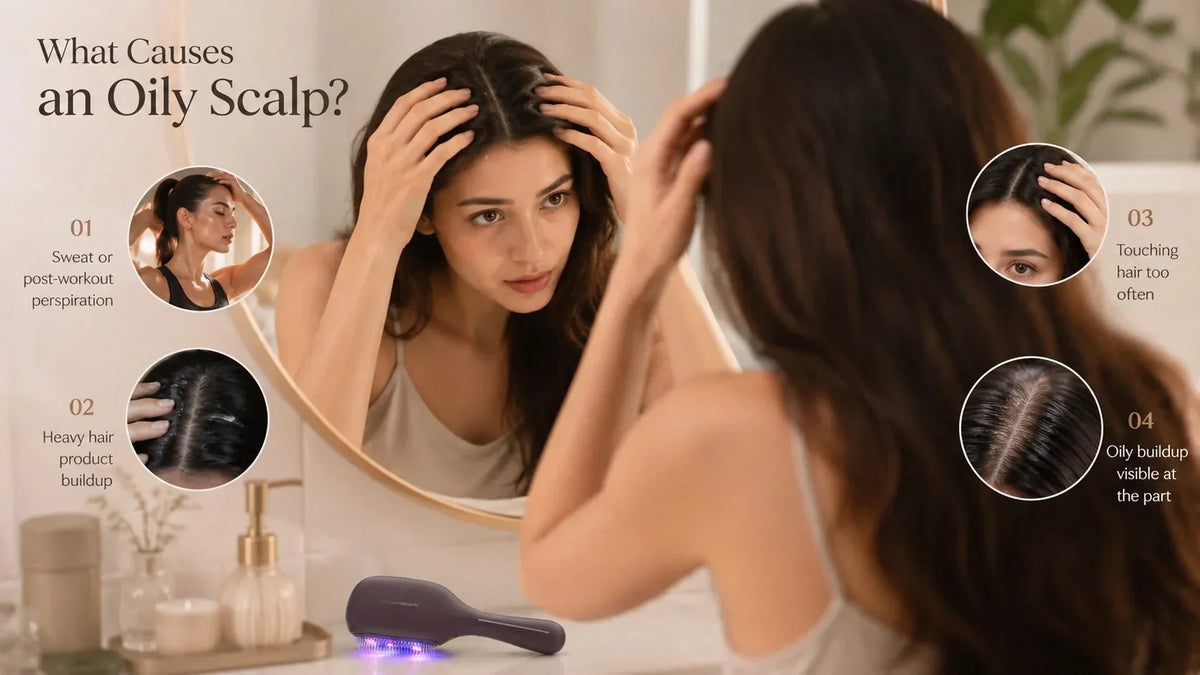
What Causes an Oily Scalp?
Your scalp contains sebaceous glands that naturally produce sebum, an oily substance that helps protect the skin and hair. Sebum is a normal part of scalp health, but the amount produced varies from person to person.
If you frequently experience greasy roots, several factors may contribute to an oily-looking scalp.
1. Natural Sebum Production and Hormones
Some people naturally produce more scalp oil than others. Genetics, hormonal fluctuations, and individual skin characteristics can influence sebum production.
This is one reason why two people using the same shampoo may experience very different levels of scalp oiliness.
2. Fine or Straight Hair
Fine and straight hair often shows oil more noticeably because sebum can spread along the strands more easily. Natural oils may weigh down fine hair, making roots look flat, shiny, or greasy even when oil production is within an individual's normal range.
If your hair loses volume shortly after washing, your hair texture may be contributing to the appearance of greasy roots.
3. Styling Product Buildup
Dry shampoo, styling sprays, leave-in treatments, and hair oils can leave residue when used frequently or not washed out thoroughly.
Over time, accumulated product residue may make your roots feel heavy or coated. Choosing suitable products and cleansing thoroughly can help manage buildup.
4. Sweat, Heat, and Humidity
Workouts, warm weather, and humid environments can make your scalp feel sweaty and your hair appear oily more quickly.
Sweat and sebum are different substances, but they can combine with styling residue and contribute to a heavy feeling around the roots.
5. Everyday Hair Care Habits
Applying heavy conditioner near the scalp, frequently touching your hair, or using too many styling products can make oily roots look worse.
These habits do not necessarily increase sebum production, but they may contribute to the appearance of greasy hair.
Why Does My Hair Get Greasy So Quickly After Washing?
If your hair becomes oily just one day after washing, you may wonder whether your shampoo is working properly.
In many cases, the explanation is a combination of natural oil production, hair texture, and styling habits.
- Your scalp naturally produces oil: Sebum production continues after washing, so roots can become shiny again within hours or a day.
- Your hair is naturally fine: Oil can become more visible along fine strands, making your hairstyle lose volume more quickly.
- Product residue remains: Incomplete rinsing or frequent use of styling products may contribute to a heavy, coated feeling.
- Your scalp needs a different washing schedule: Some people with oily scalps need more frequent cleansing than others.
Does washing your hair every day make it oilier? Not necessarily. Frequent washing does not automatically cause your scalp to produce more sebum. If your scalp becomes oily quickly, washing more often with a gentle shampoo suitable for your hair may be appropriate.
According to the American Academy of Dermatology (AAD), washing frequency should reflect how quickly hair becomes oily or dirty; daily shampooing may suit people with straight hair and an oily scalp. There is no single ideal schedule for every hair texture.
Oily Scalp vs. Product Buildup: What's the Difference?
An oily scalp and product buildup can feel similar, but they are not exactly the same. Understanding the difference can help you choose the right hair care approach.
| Concern | Common Signs | What May Help |
|---|---|---|
| Natural scalp oil | Shiny roots and greasy-looking hair between washes | Suitable washing frequency and gentle shampoo |
| Product buildup | Heavy, coated, or waxy-feeling hair | Thorough rinsing and occasional clarifying shampoo when suitable |
| Sweat and humidity | Damp, flattened roots after exercise or heat exposure | Refreshing or washing the hair as needed |
If your scalp is oily but your ends feel dry, consider using different care approaches for each area: cleanse the roots and condition the lengths and ends.
Is an oily, flaky scalp the same as dandruff?
Not necessarily. Oily roots, visible flakes and frizzy lengths are distinct concerns, although they can occur together. Oil and cosmetic buildup can affect how fresh roots look, while dandruff may require a different approach. Frizz is mainly a hair-shaft and styling concern. If flakes persist, see our dandruff vs. dry scalp guide and the AAD dandruff guidance. If oily roots and frizzy ends occur together, focus on cleansing the roots and conditioning the lengths rather than trying to treat both with the same product.
How to Manage an Oily Scalp Without Overwashing
A practical oily scalp care routine does not need dozens of products. A few consistent habits can help keep roots feeling fresh and hair looking more manageable.
1. Choose a Shampoo That Suits Your Scalp
Use a gentle shampoo suitable for your hair and scalp type. If your scalp is naturally oily, you may need to wash daily or every other day. Other people may need to wash less frequently.
Focus on cleansing the scalp with your fingertips rather than aggressively scrubbing the hair lengths. Rinse thoroughly to remove shampoo and residue.
2. Keep Conditioner Away From Oily Roots
If your roots become greasy easily, try applying conditioner mainly from the mid-lengths to the ends.
This helps care for dry strands without unnecessarily weighing down your roots. Lightweight formulas may be particularly suitable for fine hair.
3. Avoid Excessive Styling Product Buildup
Dry shampoo can temporarily absorb oil and refresh the appearance of greasy roots, but it does not clean the scalp like shampoo and water.
Avoid layering too many heavy products directly onto the roots. If your hair feels coated, an occasional clarifying shampoo may help remove accumulated residue when suitable.
4. Incorporate Gentle Scalp Massage
Scalp massage can be a relaxing addition to your hair care routine. You can use your fingertips or a suitable scalp massage tool.
Apply comfortable pressure and avoid scratching, pulling, or irritating the scalp.
Keep in mind that scalp massage does not replace cleansing and is not proven to reliably reduce sebum production.
Want to understand the benefits and limitations of scalp massage tools? Read our guide: Is a Scalp Massager Good for You?
5. Stay Consistent With Your Hair Care Habits
Instead of constantly switching products, pay attention to how your scalp responds to your current routine.
Focus on appropriate cleansing, lightweight conditioning, managing product buildup, and gentle scalp care.
For a more comprehensive guide to everyday scalp care, explore our Scalp Care Routine at Home article.
How to Refresh Greasy Roots Between Washes
Sometimes your hair needs a quick refresh before your next wash day. These simple habits can help improve the appearance of greasy roots temporarily.
- Use dry shampoo sparingly: Follow the product instructions and remove accumulated residue during your next wash.
- Avoid heavy products at the roots: Apply richer conditioners and hair oils mainly to areas that need them.
- Reduce unnecessary touching: Frequent handling can transfer residue and disturb your hairstyle.
- Choose lightweight styling products: Look for formulas that suit your hair texture.
- Try a different hairstyle: Changing your parting or choosing a loose hairstyle can temporarily make flat roots less noticeable.
These methods can make your hair look fresher between washes, but they do not remove sebum in the same way as cleansing.
Can an Electric Scalp Care Comb Help With Oily Roots?
An electric scalp care comb can complement a regular hair care routine by adding features such as vibration massage, negative ion technology, and device-specific light-based care.
However, a scalp care device is not a substitute for shampoo. An oil-control mode also does not automatically mean that a device has been proven to reduce sebum production.
When choosing an electric scalp care comb, consider its actual functions, comfort, cleaning requirements, and recommended usage.
Meet the TOUCHBeauty VITA Scalp Care Comb
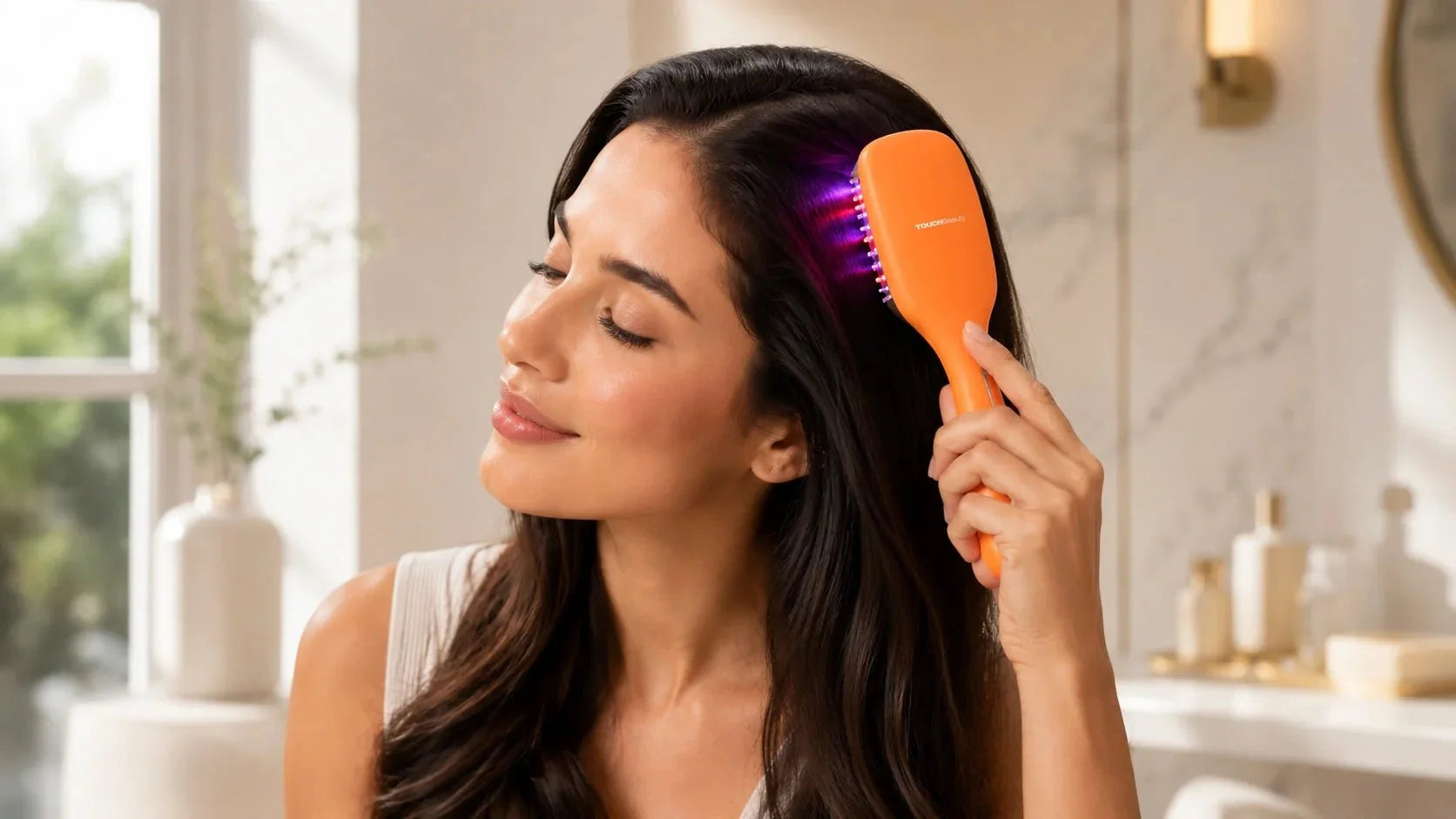
The TOUCHBeauty VITA Scalp Care Comb is a multifunctional electric scalp care device designed to bring several beauty technologies into one at-home hair care routine.
Its features include:
- Sonic vibration: Adds a relaxing scalp massage sensation.
- Negative ion technology: Helps reduce the appearance of frizz and static for smoother-looking hair.
- EMS microcurrent: Provides an additional electronic scalp care feature.
- Red and blue LED light: Integrated light-based care features.
- Low-level laser technology: An additional technology within the device's multifunctional design.
- Detachable magnetic comb head: Makes routine cleaning and maintenance more convenient.
For people whose roots feel oily or flat, VITA offers a structured scalp care experience while its negative ion feature supports smoother-looking, more manageable hair.
VITA (model TB-2343) includes an OIL-CONTROL+ mode for an oily-scalp-focused routine. TOUCHBeauty describes the device's scalp-care technologies as including 460 nm blue LED light, EMS microcurrent and sonic vibration. These features complement cleansing; they do not remove accumulated sebum and styling residue in the same way as shampoo. The mode name itself is not proof of efficacy.
What does the SGS evaluation say about oily scalp?
In a manufacturer-commissioned human performance evaluation, SGS-CSTC Standards Technical Services Co., Ltd., Guangzhou Branch assessed a VITA Multi-Function Hair Care Comb regimen over 56 days (report GZCPCH24005312-01_EN, November 28, 2024). The evaluation included valid data from 32 Asian adults aged 25–52 (29 women and 3 men), selected for oily scalp and mild thinning or excessive shedding concerns.
| Assessment | Mean (µg/cm²) | Change vs. baseline |
|---|---|---|
| Day 0 | 124 | — |
| Day 28 | 93 | −25.00% |
| Day 56 | 86 | −30.65% |
Source: SGS report, pp. 7, 18–20. Sebumeter SM815 measurements near the parietal area; both post-baseline comparisons p < 0.001. Values are group means, not individual predictions.
At Day 56, 93.8% of participants also rated improvement in scalp oiliness as satisfactory (a questionnaire score above 3 on a 5-point scale). This is a self-reported satisfaction measure, not an instrument-measured oil reduction percentage (report pp. 12, 29).
How the regimen was tested: participants used ALL-IN-ONE mode once daily for about five minutes, with the third intensity level recommended, alongside a collagen moisturizing scalp essence. The report does not describe a separate untreated or sham-device comparison group. It therefore cannot isolate the effect of the comb, the essence, OIL-CONTROL+ mode or blue light alone. These results are not a guarantee of individual performance or evidence of treatment for dandruff. Follow the current consumer instructions below rather than reproducing the test regimen.
For more about the device and its evidence, see our TOUCHBeauty VITA comb guide.
How to Use VITA in Your Scalp Care Routine
- Start with clean, completely dry hair and scalp.
- Choose the mode that best suits your needs, following the product instructions.
- Part your hair when needed so the comb pins can contact the scalp.
- Glide the comb gently across the scalp without applying excessive pressure.
- Complete a session of approximately five minutes.
For OIL-CONTROL+, REVITALIZE+, and ALL-IN-ONE, follow the recommended 3–5 sessions per week. MASSAGE+ may be used more frequently according to the product instructions.
Always review the official usage and safety guidance before using an electronic scalp care device.
Keep the electronic body dry. Remove the magnetic head for cleaning according to the manual, and let it dry completely before reattaching. Do not apply oils, creams or wet scalp products immediately before routine device use unless specifically permitted by the instructions. This differs from the SGS test protocol.
Give Your Scalp Care Routine an Upgrade
Discover TOUCHBeauty VITA, featuring four care modes and multiple beauty technologies in one convenient scalp care comb.
When Should You See a Dermatologist About an Oily Scalp?
Oily roots alone are usually not a cause for alarm. However, persistent scalp discomfort may require more than changes to your beauty routine.
Consider speaking with a dermatologist or qualified healthcare professional if you experience:
- Persistent or intense itching.
- Redness, soreness, or inflammation.
- Significant flaking or crusting.
- Sudden or unusual hair shedding.
- Scalp symptoms that do not improve with appropriate care.
Conditions such as seborrheic dermatitis can involve an oily, flaky scalp and may require specific treatment.
Beauty tools should not be used as substitutes for medical evaluation or treatment.
Build a More Complete Scalp Care Routine
Understanding why your scalp gets oily is the first step toward better hair care. For a more complete approach, explore our guide to building an effective scalp care routine at home, including gentle cleansing, scalp massage, brushing techniques, and modern scalp care tools.
Read our Complete Scalp Care Guide →
Looking for a more advanced way to care for your roots? Discover the TOUCHBeauty VITA Scalp Care & Hair Revitalizing Comb, combining EMS, sonic vibration, negative ions, LED light, and low-level laser technology in one convenient device.
Frequently Asked Questions About Oily Scalp
1. Why does my scalp get oily after one day?
Your scalp naturally produces sebum. Individual oil production, fine hair, sweat, and styling product residue can make roots look greasy within a day. This does not necessarily mean your hair is dirty.
2. Should I wash oily hair every day?
Daily washing can be appropriate for some people with oily scalps, especially those with fine or straight hair. Choose a gentle shampoo and adjust the frequency according to your scalp and hair needs.
3. How can I refresh greasy roots without washing?
You can use dry shampoo sparingly, avoid heavy products at the roots, and adjust your hairstyle. These steps can temporarily improve appearance, but washing is needed to properly remove oil and product buildup.
4. Does scalp massage reduce oil production?
Scalp massage can provide a relaxing experience, but there is not enough evidence to conclude that it reliably reduces sebum production. Proper cleansing remains an important part of managing oily roots.
5. Can an electric scalp care comb replace shampoo?
No. An electric scalp care comb can complement your routine with massage and other device-specific features, but it cannot replace regular cleansing with shampoo and water.
6. Does the VITA Comb have test results for oily scalp?
Yes. In the 56-day SGS evaluation, mean measured scalp sebum fell 30.65% from baseline in 32 participants using VITA ALL-IN-ONE mode together with a collagen moisturizing scalp essence. The evaluation did not isolate VITA or OIL-CONTROL+ alone, so individual results may differ. It does not replace regular shampooing.
Final Thoughts: Understand Your Scalp, Care for Your Roots
If you're wondering why your scalp gets oily so fast, remember that natural sebum production, hair texture, styling products, and everyday habits can all contribute.
The best approach is to understand your individual scalp needs rather than trying to eliminate natural oil completely. Focus on suitable cleansing, lightweight products, and avoiding unnecessary buildup.
If you enjoy incorporating beauty technology into your routine, a multifunctional scalp care device can add another dimension to your hair care experience.
Explore the TOUCHBeauty VITA Scalp Care Comb and discover its four care modes, massage features, and at-home scalp care experience.

Leave a comment
This site is protected by hCaptcha and the hCaptcha Privacy Policy and Terms of Service apply.