



Your hair care routine may already include a shampoo, conditioner, treatment mask and styling products. But there is another part of the routine worth paying attention to: the scalp. If your roots become oily quickly, your hair feels static-prone, or you simply want a more consistent at-home care ritual, a multifunctional scalp comb may be worth exploring.
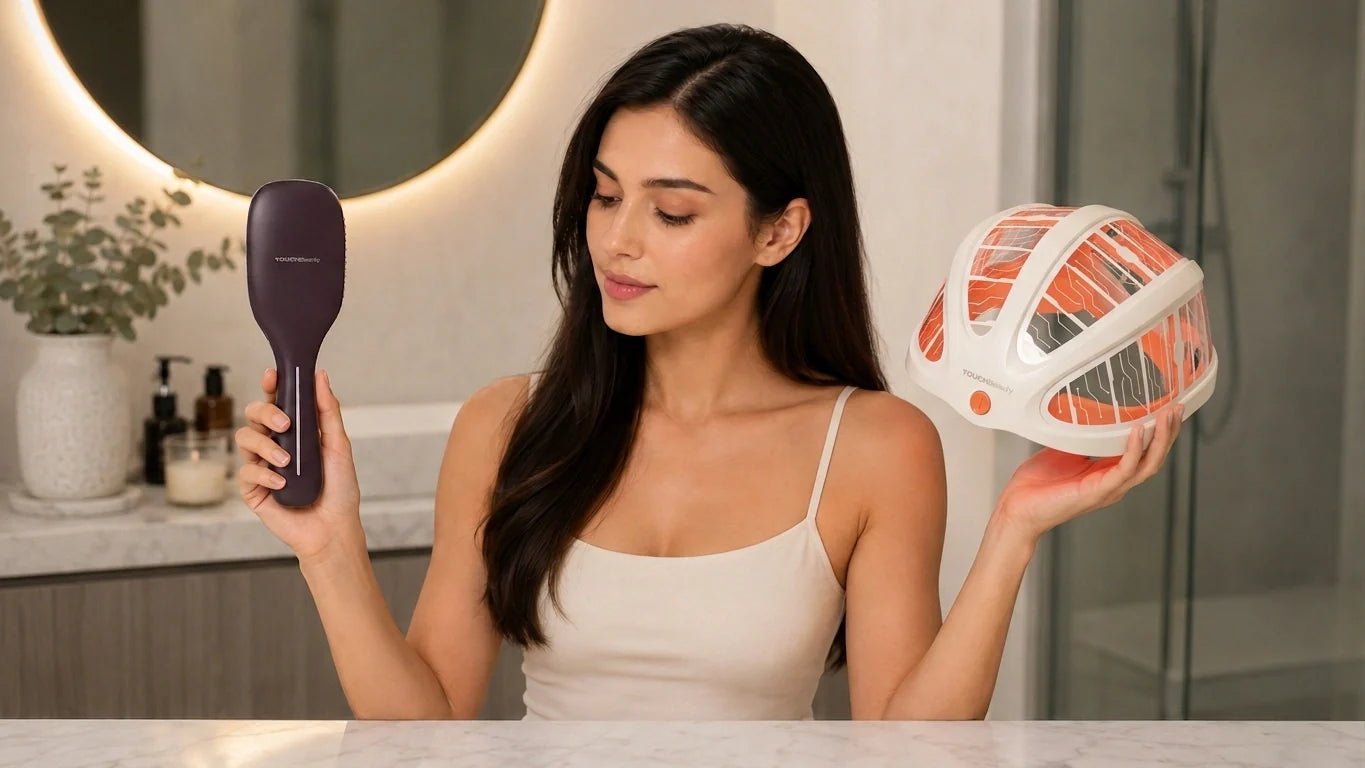
The TOUCHBeauty VITA Scalp Care Comb combines brushing with red LED light, blue LED light, low-level laser technology, EMS microcurrent, negative ions and sonic vibration. Instead of promising overnight results, this guide explains what the features do, the four available modes, the reported SGS test findings, and the exact scope of the device's U.S. FDA clearances.

Product naming: This guide refers to the TOUCHBeauty VITA Comb as TB-2343. Regulatory documents may include an additional suffix; refer to the model printed on your device and packaging for exact clearance matching.
What Is the TOUCHBeauty VITA Scalp Care Comb?
FDA 510(k) clearance is available for specifically named VITA models and indications. The consumer-facing model name in this article is TB-2343. The FDA entries use the regulatory model identifier TB-2343F, among others. These identifiers should not automatically be treated as identical: confirm that the TB-2343 SKU being sold corresponds to the cleared TB-2343F regulatory configuration before applying a clearance claim directly to that item.
FDA K252053: specified light-based uses
The FDA 510(k) record K252053 (decision October 27, 2025) lists TB-2443F, TB-2442AF, TB-2343F and TB-2442F. Its defined head-mode indication includes promotion of hair growth in specified groups of men and women with androgenetic alopecia, subject to the hair-loss classification and skin phototype criteria in the official record. It is not a blanket statement that the device treats every form of hair loss.
FDA K260179: a separately cleared microcurrent function
The FDA 510(k) record K260179 (decision June 3, 2026) names TB-2343F and TB-2442F for a specific aesthetic transcutaneous microcurrent function. Its cleared purpose is distinct from evidence that EMS treats scalp hair loss.
Important regulatory distinction: in U.S. device terminology, these functions are FDA-cleared, not “FDA-certified” or “FDA-approved.” Regulatory indications are specific to model and function. The SGS evaluation is a separate performance evaluation; it is not an FDA clearance.
Who Is the VITA Scalp Care Comb For?
1. People Concerned About Oily Roots
Scalp oil is produced naturally by sebaceous glands. An oily scalp is not necessarily unhealthy, and oil production can vary with hormones, climate, washing habits and individual biology. The VITA's OIL-CONTROL+ mode combines blue LED light, EMS microcurrent and vibration as part of a scalp-focused routine.
TOUCHBeauty has published results from an SGS evaluation that measured scalp oil levels over 56 days. Those results are discussed in detail below; they should not be interpreted as a permanent change to sebum production or as a substitute for treating a scalp disorder. For washing habits and common causes, see Why Does My Scalp Get Oily So Fast?.
2. People with Frizz, Flyaways or Static-Prone Hair
Frizz is often linked to humidity, surface damage, and the way hair interacts with moisture; static can also make flyaways more noticeable. The VITA's 20 million+ negative ions, stainless-steel teeth and sonic vibration offer a more comprehensive brushing experience. The goal is smoother-looking, more manageable hair—not a permanent change in hair structure.
Our related guide explains the difference between ionic grooming and simple anti-frizz habits: Ionic Hair Brush Benefits.

3. People Exploring Light-Based Hair and Scalp Care
The combination of 650nm low-level laser light and 660nm red LED light is one of the VITA's differentiating features. Certain laser-comb devices have FDA-cleared uses for promoting hair growth in specific groups of people with androgenetic alopecia. This is a defined regulatory indication, not a promise that the product will reverse every type of hair loss. See the FDA section below for the actual models and indicated populations.
4. People Who Prefer an Integrated Five-Minute Ritual
The four settings combine different technologies in one rechargeable device. That can make a regular routine easier to maintain than purchasing and using separate tools for every step. The detachable head is designed to simplify cleaning, while the adjustable intensities help tailor the experience to comfort.
How Does VITA's Scalp Care Technology Work?
460nm Blue LED Light
Blue light is included in OIL-CONTROL+ and ALL-IN-ONE modes. Different blue-light applications have been explored in dermatology; however, those findings cannot automatically be applied to every device or scalp concern. In this comb, blue LED is one element of the manufacturer's scalp care system, not an independent proof that it treats dandruff or a medical scalp condition.
650nm Low-Level Laser and 660nm Red LED Light
Laser light and LED light are not interchangeable descriptions. Both can fall within light-based care, but optical characteristics and dose matter. The VITA combines 650nm low-level laser light and 660nm red LED light in certain modes. Research on low-level light devices provides context for hair-growth applications; outcomes are device- and protocol-specific. Read more in our Red Light Therapy for Hair Growth guide and Laser Hair Growth Comb evidence review.
EMS Microcurrent Through Stainless-Steel Teeth
EMS is a form of electrical stimulation. In the VITA, the system uses the conductive stainless-steel comb teeth. How electrical stimulation behaves depends on current parameters, application area and contact conditions. It is incorrect to equate every EMS feature with clinically proven hair regrowth. The FDA clearance for VITA's microcurrent function is described separately below and has its own specified use.
For a dedicated explanation of electrical scalp care, visit EMS Scalp Therapy: Benefits and Evidence.
Negative Ions and 16,000 RPM Sonic Vibration
Negative-ion technology is familiar from other hair care tools and is used here to support brushing and static management. Sonic vibration adds a gentle mechanical component to the combing ritual. Neither feature by itself should be described as curing dermatitis, repairing damaged follicles, or guaranteeing a particular growth rate.

Four VITA Care Modes Explained
| Mode | Technologies | Suggested focus |
|---|---|---|
| MASSAGE+ | Sonic vibration + negative ions | Everyday brushing, massage experience, static-prone hair |
| OIL-CONTROL+ | Blue LED + EMS + vibration | Scalp-focused routine for oily-feeling roots |
| REVITALIZE+ | Negative ions + EMS + red LED + low-level laser | Light-based hair and scalp care |
| ALL-IN-ONE | Vibration + ions + EMS + blue LED + red LED + low-level laser | Combined multi-technology session |
Choose a mode in accordance with the device manual and your comfort level. The mode names describe combinations of functions; they are not guarantees of specific outcomes.

What Does the SGS 56-Day Evaluation Report Show?
Real test results matter—but so does how a product was tested. SGS-CSTC Standards Technical Services Co., Ltd., Guangzhou Branch issued Evaluation Report GZCPCH24005312-01_EN on November 28, 2024 for the VITA Multi-Function Hair Care Comb. The report evaluated changes in scalp oil, local hair density, local hair count and hair counts collected during a standardised combing assessment.
What did the 56-day SGS evaluation involve?
- 32 participants with valid results: 29 women and 3 men, Asian adults aged 25–52. Thirty-three participants were enrolled in the evaluation, and one discontinued for personal reasons.
- Duration: 56 consecutive days, with assessments at baseline (Day 0), Day 28 and Day 56.
- Test routine: once daily for approximately five minutes using the device's ALL-IN-ONE mode at the recommended third intensity level, in combination with a collagen moisturising scalp essence applied to specified areas.
- Measurements: scalp sebum measurement by Sebumeter SM815; local hair density and hair count assessed with DermoGenius/TrichoScan imaging; a technician's 60-stroke combing hair-count method; dermatologist assessment and participants' self-assessments.
SGS results after 28 and 56 days
| Reported measure | Day 28 vs baseline | Day 56 vs baseline |
|---|---|---|
| Measured scalp sebum content | -25.00% | -30.65% |
| Local hair density (imaging) | +4.61% | +5.01% |
| Local hair count (imaging) | +4.65% | +5.21% |
| Hair count collected by 60-stroke combing | -31.32% | -47.38% |
| Dermatologist-assessed overall hair density score | +8.09% | +14.36% |
Source: SGS Evaluation Report GZCPCH24005312-01_EN, summary tables on pp. 7–8 and detailed results on pp. 18–27. The report describes the changes above as statistically significant compared with baseline. For example, Day 56 sebum content: p<0.001; local hair density: p=0.006; local hair count: p=0.004; combing-count measure: p<0.001.
What did users report?
At Day 56, 93.8% of evaluated participants reported satisfaction with improvement in scalp oiliness, and 93.8% reported satisfaction with smoother, more supple-feeling hair. These are self-assessed satisfaction percentages, not instrument-measured efficacy rates or guaranteed consumer outcomes.
What the SGS evidence does—and does not—prove
These are encouraging within-group measurements from the tested routine. However, the evaluation did not describe a separate untreated or sham-device control group. Because the protocol paired the VITA with a collagen moisturising scalp essence, the report cannot isolate how much of the observed changes came from the comb alone, the essence, or other factors. Participants also represented a defined group with mild thinning/oily-scalp concerns; people with certain scalp conditions or severe forms of alopecia were excluded.
For that reason, the figures should always be described as results observed in the SGS-evaluated regimen—not promises that every TB-2343 customer will experience the same percentages, and not proof of effectiveness for all kinds of hair loss.
Report note: SGS states that the evaluation results relate to the submitted information/sample, must not be used for exaggerated publicity, and are not a medical-device clinical trial by SGS. The report states that its Chinese version (GZCPCH24005312-01_CN) prevails in the event of a translation discrepancy.
Is the TOUCHBeauty VITA Comb FDA Cleared?
Yes—FDA 510(k) clearance records exist for specified VITA Multi-Function Head Brush models and functions. In the United States, “FDA-cleared” is not the same term as “FDA-approved.” A 510(k) decision concerns substantial equivalence and the indications specifically described in the FDA record; it does not establish that every function treats every scalp condition.
FDA 510(k) K252053: Light-Based Functions
FDA record K252053, with a decision date of October 27, 2025, lists VITA models TB-2443F, TB-2442AF, TB-2343F and TB-2442F. Its head-mode indication concerns promoting hair growth in specified male and female populations with androgenetic alopecia and Fitzpatrick skin phototypes I–IV, as detailed in the official FDA indication. It is not a blanket clearance for all possible reasons for hair loss or every user.
FDA 510(k) K260179: Microcurrent Function
FDA record K260179, dated June 3, 2026, covers the microcurrent stimulation function for over-the-counter facial cosmetic stimulation in listed VITA models TB-2343F and TB-2442F. This particular clearance does not establish an EMS indication for treating scalp hair loss.
Before purchasing or relying on an indicated use: verify the exact model on the product label, follow its instructions, and refer to the FDA record's full indications and exclusions. These clearances should not be described as a universal FDA endorsement of the product's cosmetic, oil-control or scalp-related claims.

How to Use the VITA Comb in Your Hair Care Routine
- Start with clean, completely dry hair and scalp. Gently detangle first, and do not use the powered functions on wet hair unless your device's own instructions explicitly permit it.
- Choose the mode that fits your goal. MASSAGE+ is the simplest daily option; the other modes introduce combinations of light and EMS. Start at a comfortable lower intensity when appropriate.
- Comb slowly for approximately five minutes. Maintain light contact without pressing hard, scraping or repeatedly working over irritated skin.
- Follow the manufacturer's frequency guidance. TOUCHBeauty's Global product page suggests OIL-CONTROL+, REVITALIZE+ and ALL-IN-ONE about three to five times per week, and MASSAGE+ may be used daily.
- Clean the removable head correctly. Detach the magnetic comb head before rinsing it according to the manual. Let it dry fully before reconnecting; do not rinse or immerse the electronic body.
A consistent routine does not mean longer or more intense sessions are better. Stop use if you experience pain, unusual tingling or irritation, and consult the instructions and a qualified professional about contraindications such as implanted electronic devices or broken skin.
For a full wash-day-to-everyday plan, see our Complete Scalp Care Guide.

VITA Scalp Care Comb FAQ
1. Does the VITA Comb have FDA clearance?
FDA records K252053 and K260179 include the regulatory model TB-2343F, among other listed versions, for defined functions and indications. This article discusses the consumer-facing TB-2343; verify the exact product-label/regulatory configuration before representing your particular unit as covered by those records.
2. Does SGS testing show changes in scalp oil and hair-related measurements?
Yes. SGS report GZCPCH24005312-01_EN followed 32 Asian adults for 56 days. In the tested daily VITA + collagen moisturising scalp essence regimen, the mean changes at Day 56 included -30.65% measured scalp sebum, +5.01% local hair density, +5.21% local hair count and -47.38% hair counts collected by the 60-stroke combing method. The report does not isolate the comb-only effect or guarantee personal results.
3. Is the VITA Comb suitable for oily scalps?
OIL-CONTROL+ combines blue LED light, EMS and vibration for a scalp-focused session. It can be part of an everyday routine, but does not replace shampoo or medical treatment for persistent scalp symptoms.
4. Can the VITA Comb help with frizzy hair?
Its negative-ion technology and brushing functions are designed to help manage static and flyaways. Hair condition and humidity still influence the appearance of frizz.
5. What is the difference between red light and low-level laser in the VITA?
The product includes 660nm red LED light and 650nm low-level laser light. Their characteristics and application parameters differ, so they should not be treated as identical technologies.
6. How often should I use the VITA Comb?
The current Global product instructions recommend using targeted modes three to five times weekly, with MASSAGE+ available for daily use. Follow the specific instructions and precautions supplied with your unit.
7. Can I wash the whole device?
No. The detachable head is described as IPX6 water-resistant and may be rinsed according to its instructions. The electronic body must remain dry.
8. How long does a full charge last?
TOUCHBeauty's official product materials state that a full charge may support approximately two to three weeks of use, depending on mode, duration and usage frequency.
Final Takeaway: A Scalp-to-Strand Routine Backed by Defined Product Information
The TOUCHBeauty VITA Comb stands apart from an ordinary brush through its combination of ionic grooming, vibration, EMS and light-based technologies. Its official technical specifications explain what is built into the device; the SGS evaluation provides measured outcomes under reported test conditions; and FDA 510(k) records describe the particular models and uses cleared in the United States.
The most useful way to assess a scalp care device is to understand your actual needs, its exact features, the scope of its evidence, and how comfortably it fits into your routine.


Leave a comment
This site is protected by hCaptcha and the hCaptcha Privacy Policy and Terms of Service apply.